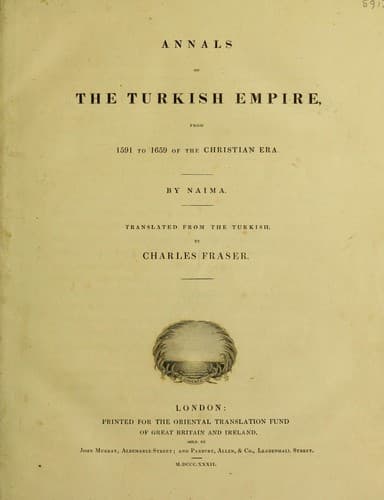
Annals of the Turkish Empire, from 1591 to 1659Naima, Mustafa
History
Annals of the Turkish Empire, from 1591 to 1659
Naima, Mustafa
Turkey -- History -- 1453-1683
Lálá Mohammed Páshá, as before hinted, left Buda and came to Belgrade,
whence he issued orders to all the troops to assemble at his
head-quarters. After these orders had been attended to, and the various
troops had accordingly assembled at Belgrade, he found it would be
too late in the year to wait for the arrival of the janissaries, whom
the túrnají báshí was conducting to him from Constantinople, or for
Delí Hasan (lately a powerful and mischievous rebel). In short, the
season had already been far advanced, and therefore Mohammed Páshá
returned towards Buda with the whole of his army. After crossing the
bridge of Usk he encamped at a place called Kúrwah, where he received
a visit from Delí Hasan Páshá, now the beglerbeg of Bosnia. When this
man first came over to Romeili, under the semblance of having returned
to obedience, he still cherished in his heart, notwithstanding this
appearance, his old sentiments of disaffection. For some small offence
which the master of the vessel in which he sailed from Anatolia had
given him, he got into a rage and shot him dead. His conduct at
Adrianople was still more flagrant. He collected there, by violence,
an immense quantity of spoil; robbed the saddler of that place of
all the furniture he had in his premises; laid a heavy contribution
on the inhabitants, and did not leave the place till a certain number
of _yúks_ of money had been given to him. He acted in this tyrannical
way at Philippopolis, Sofia, and other cities through which he passed
with his troops, amounting to ten thousand foot and horse, on his
way to join the commander-in-chief. These troops had a most strange
appearance. Many of them were naked-looking wretches, wearing amulets
and chains about their necks; others of them had camel-bells fixed to
their stirrups, and also wore amulets and chains on their backs; others
were without caps or bonnets, and wore long hair like women, divided
into tresses; others again had no covering for their legs. Each man of
this motley crew carried a sort of spear, having a white flag about two
spans long at the top. Thus arranged and accoutred, they surrounded the
serdár’s tent with their matches burning in their hands, and crooked
daggers stuck in their girdles. After having arranged themselves
properly and being put in right order, the serdár sent one hundred and
forty garments for the better sort amongst them, and cloth for as many
more. Four hundred of them offered to enter the ranks of the serdár;
but he replied he would see about it, and afterwards dismissed this
savage-looking multitude.
Public-domain text, read in full here on John Shaqi.
Reviews
Reviews
No reviews yet
Be the first to share your thoughts on this work.
Elsewhere in the archive
Join the Discussion
Join the discussion
Sign in to leave a comment or review.
Sign InorCreate an account