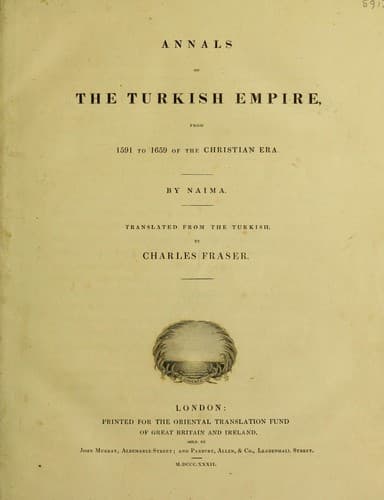
Annals of the Turkish Empire, from 1591 to 1659Naima, Mustafa
History
Annals of the Turkish Empire, from 1591 to 1659
Naima, Mustafa
Turkey -- History -- 1453-1683
Ibrahím Páshá, cousin to the commander-in-chief, should conduct this
expedition. This was opposed by another party, who proposed that Murád
Páshá, beglerbeg of Romeili, with his provincial troops, should be
sent. This was also rejected; and it is no wonder if the conflicting
opinions which prevailed in the Moslem camp on this occasion should
have proved the means of its utter ruin and destruction. From this very
terrible result, however, they were saved, though at the expense of
many lives.
Dervísh Páshá, who had been deposed from the government of Bosnia, was
finally fixed on to conduct the expedition. On his reaching a bridge
which the Moslems had just constructed for his use, he broke out
into a rage when he saw it, and declared it altogether defective and
dangerous. Mohammed Páshá, when the fact was explained to him, smoothed
him down by telling him it should be, without delay, put into a proper
state. “I need only tell you,” said the serdár, “in order to secure
your services, that the janissaries in Constantinople, in consequence
of their having met with the emperor’s countenance, and that of the
prime minister, have become excessively tyrannical and turbulent. When
you reflect on this, and when you consider that those of the same body
of men amongst us here have manifested a similar spirit, you will not,
I am sure, flinch from the duty assigned you.” This speech had the
desired effect. Dervísh swore that he regarded his own life no more
than he did a draught of water. “My reflection forbids me,” answered
he, with no small degree of generous warmth, “to feel concern about
self, but it demands of me, on the other hand, to be every way alive
to the interests of my government, and to the glory of my religion.
No sacrifice can be too great for either of these.” Thus saying, he
proceeded. By means of boats four or five thousand horse and ten
thousand foot were conveyed across to the above island under covert of
the night.
It is very singular, as well as very remarkable, that at this time
Mohammed Páshá was visited by a sort of deep lethargy, which seemed
extremely alarming; so much so, in fact, that he could not raise his
head, and when he opened his eyes he spoke nonsense. In the meantime
midnight had passed away, and the troops, which had effected a descent
on the island of Chíl, had made no trenches nor erected any bastions.
The segbáns who formed part of the expedition obstinately refused to
open trenches. “We fought on the other side,” said they, “without the
use of trenches, and we will not use them here.” The other janissaries,
however, dug trenches for themselves.
Public-domain text, read in full here on John Shaqi.
Reviews
Reviews
No reviews yet
Be the first to share your thoughts on this work.
Elsewhere in the archive
Join the Discussion
Join the discussion
Sign in to leave a comment or review.
Sign InorCreate an account