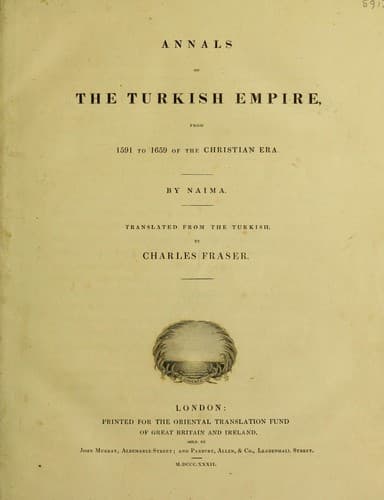
Annals of the Turkish Empire, from 1591 to 1659Naima, Mustafa
History
Annals of the Turkish Empire, from 1591 to 1659
Naima, Mustafa
Turkey -- History -- 1453-1683
His royal highness Ghází Gheráí, khán of the Crimea, who had wintered
at Petcheví, made an excursion into the enemy’s dominions, but had not
been so successful in the enterprize as he at first anticipated. When
the commander-in-chief[11] was on his way from Buda to Belgrade he paid
his royal highness a visit; but on account of some misunderstanding or
other, the khán returned to his own dominions without offering, in any
way, to assist the besieged in Buda, which we lately left under the
command of Mohammed Páshá, afterwards appointed commander-in-chief. The
enemy’s camp, below Pest, was about fifty thousand strong. They had
constructed a bridge across to the island of Chíl, and occupied that
island with the view of preventing boats passing with provisions to
Buda.
When the army under Mohammed Páshá, the commander-in-chief, had taken
up its position in the neighbourhood of the enemy’s camp, the whole
of the enemy’s guns were directed against the Moslems, who, from the
necessity they were under of preparing themselves trenches, were not
in a condition to act on the offensive, or even on the defensive.
The Moslems appeared, even to themselves, to have been in a dilemma
at this time, and did not seem to know how to conduct their military
manœuvres. They were aware, at least some of their leaders were so,
that if they had sent out detachments to harass the country around
Pest, the enemy would not fail to take advantage of this, and come
and attack them when less able to offer them effectual resistance. As
the recovering of Buda was their chief object, they were unwilling to
retire before they had at least supplied it with a sufficient quantity
of provisions, and thus encourage the Budians to maintain their heroic
resistance. The opinions of the warriors, however, were various and
conflictive: one party proposed one thing, another opposed this, and a
third had a new plan altogether. At length, however, now that Yemishjí
Páshá was no more at their head, they resolved on constructing bridges,
and attacking the enemy that had taken possession of the Chíl. This
was talked over and considered. Kúchuk Osmán Aghá, Fedái Beg, ághá of
the salihdárs, some emírs well acquainted with the use of small-arms,
and three thousand segbáns, with ten pieces of cannon, were ordered to
effect a landing on the island during the night, and raise bastions,
mounds, &c. The commander of the segbáns, who acted in the room of the
ághá of the janissaries, came forward, and said that he had ordered
three or four thousand of the common soldiers to this service, as it
was unnecessary, and even improper, he said, to employ the janissaries
in a species of labour which was beneath their rank in the army. These
sentiments did not sound well in the ears of those veterans who thought
otherwise; they said that the success of the undertaking depended
on the janissaries being employed in it. A warm discussion ensued,
and every one gave his own opinion. One party proposed that Serkhúsh
Public-domain text, read in full here on John Shaqi.
Reviews
Reviews
No reviews yet
Be the first to share your thoughts on this work.
Elsewhere in the archive
Join the Discussion
Join the discussion
Sign in to leave a comment or review.
Sign InorCreate an account