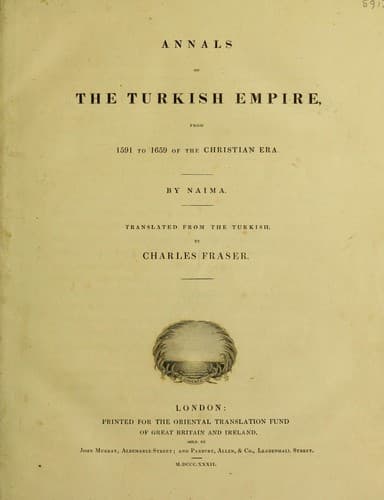
Annals of the Turkish Empire, from 1591 to 1659Naima, Mustafa
History
Annals of the Turkish Empire, from 1591 to 1659
Naima, Mustafa
Turkey -- History -- 1453-1683
It happened that on that day the reverend mufti, and other spiritual
dignitaries, had gone with their retinue to the royal palace, where
they met the new-made ághá of the janissaries, Turk Ahmed, and whom
they earnestly exhorted to retrace his steps, and not follow irregular
courses. In short, this mode of address made an impression on the
mind of Turk Ahmed, and it seems to have communicated itself to the
rest of the mutineers; for we find the janissaries suddenly changed
their minds, and said, “It is no matter of ours who is at the helm of
affairs: the emperor may appoint whom he pleases.” The unfortunate
grand vezír’s friends among the ketkhodás and chief chávushes, and some
others, still maintained his cause, and continued for a while longer
to persevere in his behalf; but they, too, when they saw that their
perseverance would end in no good in his behalf, followed the example
of the others.
This unsettled state of things continued for the space of ten days,
when ten eunuchs, under the command of the bostán báshí, by supreme
authority suddenly seized on Yemishjí Hasan Páshá in the royal mint,
dragged him forth into the garden of Khundán Aghá, and there despatched
him, leaving his friends and followers to lament over him. Thus ended
the life and activities of Yemishjí Hasan Páshá.
It may not be improper briefly to advert here to the cause of that
enmity which excited Kásim Aghá against the grand vezír, and which had
its origin in the following circumstance.
When Háfiz Ahmed Páshá was sent to the Seven Towers, and his property
seized, that part of it which was not considered fit to be appropriated
to his majesty’s own use was ordered to be sold. Kásim Aghá was the
person appointed to execute this business in the first instance; but
the grand vezír, on the part of the diván, associated with Kásim
the son Poghacha, the third treasurer. The latter, perceiving some
disposition to purloin in the former, withstood him. Kásim, fired with
indignation, said that the emperor had committed to him the sale of the
confiscated property, and asked him, with an air of disdain, by whose
authority he had ventured to mix in matters that did not belong to him.
The other defended himself, and maintained that it was the special
duty of the defterdárs to attend to matters of that kind, and not to
ághás. “Why,” said Kásim, in wrath, “I hope it will be my lot one day
to dispose in this very way of your property, and of the property of
him who sent you hither.” The treasurer, who was not possessed of
superabundant meekness, communicated these unguarded sayings to the
grand vezír, and of course displeased him exceedingly. When Kásim, some
time afterwards, appeared before him, he reproved him for his conduct,
and threatened to be revenged on him. This, then, was the cause of that
hostility and ill will manifested by Kásim Aghá, as above related, and
which also led him to other actions not less vindictive and cruel.
Public-domain text, read in full here on John Shaqi.
Reviews
Reviews
No reviews yet
Be the first to share your thoughts on this work.
Elsewhere in the archive
Join the Discussion
Join the discussion
Sign in to leave a comment or review.
Sign InorCreate an account