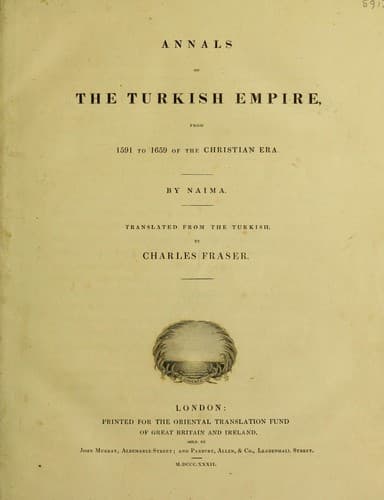
Annals of the Turkish Empire, from 1591 to 1659Naima, Mustafa
History
Annals of the Turkish Empire, from 1591 to 1659
Naima, Mustafa
Turkey -- History -- 1453-1683
After the murder of the grand vezír had been perpetrated, he not only
got the treasurer, Altí Poghacha’s son deposed, but succeeded also in
keeping him confined in the Seven Towers for a considerable time, and
caused the whole of his property to be confiscated—thus verifying, in
part at least, the truth of his own prediction. Yemishjí Hasan Páshá’s
secretary he caused to be arrested, and made him advance security for
his future conduct. Yáishá Zádeh Hamzah Effendí, the _reïs-ul-ketáb_,
or _reïs-effendí_, was by his means sent to prison, and the whole of
his property would also have been confiscated, had it not been for
the good offices of the ághá of the salihdárs, who interfered in his
behalf. Kátibmim, the secretary to Jeráh Mohammed Páshá, was made
reïs-effendí in room of Hamza Effendí.
This Kásim, though only an ághá, seems to have acted with as much
authority and controul, in fact, as if he had been possessed of
absolute and supreme dominion over the lives and fortunes of men. We
shall hear more of him just now, and still more afterwards.
_Kásim Páshá is made Governor of Constantinople._
In consequence of the káímakám having been afflicted with the gout, he
found himself unable to attend his duty in the diván, and therefore did
not appear there, except on the days on which petitions were presented
to his majesty. Hamza Páshá, the lord high chancellor, acted for him,
and gave him a detail of all such matters as usually came before that
assembly.
One day, however, Kásim Páshá (very lately only an ághá) invented
some means or other of getting the reverend mufti, Mustafa Effendí,
invited to the royal palace, where the emperor conversed with him on
topics of a general nature, and afterwards suddenly adverted to the
case of the afflicted Jeráh Páshá; spoke of the excellent fitness
of Kásim Páshá for the despatch of public affairs, and so forth. It
now began to be circulated abroad that the mufti had said that Jeráh
Páshá, the most laborious and active of all the emperor’s servants,
and the most beloved among the list of vezírs, was, in consequence of
disease, unable to attend to the arduous services which his responsible
situation demanded, or even to be present in the diván. The part which
Hamza Páshá, the lord high chancellor, had acted in the diván, was
mentioned with approbation, and, in words, encouraged; but the affairs
of government, it was said, had become so very great and numerous,
that it was absolutely impossible for him, however willing he might
be, to fulfil the duties of the governor or deputy of Constantinople;
and therefore it was considered more advantageous to the state to
allow Jeráh Páshá to retire, and appoint another able person to the
deputyship. It was urged that Kásim Páshá was a man every way qualified
for the high situation, and on the 8th of Jemadi II. Jeráh was informed
that his further continuance in office was dispensed with, and that
Kásim Páshá was appointed to succeed him.
Public-domain text, read in full here on John Shaqi.
Reviews
Reviews
No reviews yet
Be the first to share your thoughts on this work.
Elsewhere in the archive
Join the Discussion
Join the discussion
Sign in to leave a comment or review.
Sign InorCreate an account