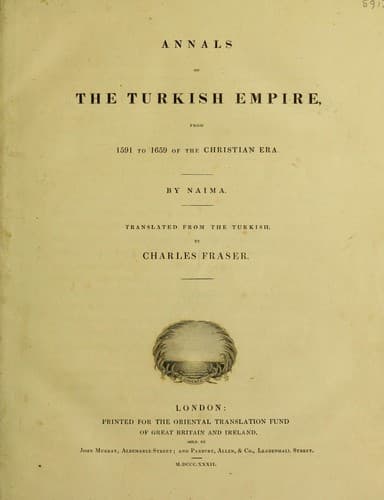
Annals of the Turkish Empire, from 1591 to 1659Naima, Mustafa
History
Annals of the Turkish Empire, from 1591 to 1659
Naima, Mustafa
Turkey -- History -- 1453-1683
Amongst those who had been thus gained over by one means or other to
the side of the heretical Persians was one Ghází Beg, a descendant of
Sháh Kúlí of Kúrdistán, and governor of Silmás. He and some of his
followers dreading the resentment of the Sublime Porte, wrote letters
to the Persian sháh to take them under his protection, and requested
him to send them aid. The fox-like sháh, however, cunningly put off
granting them their request for some little time, thinking it too early
for bringing about the base designs he had formed against the Osmánlís.
He, however, sent to Ghází Beg, by a hypocritical impure wretch of the
name of Jemshíd, a cap, a sword, and a shawl, flattering him with every
sort of promise of support from the sháh. Ghází Beg, thinking he had
got all he wanted, began to force the people of his government to wear
caps similar to the heretical one which was sent to him, instead of
those they usually wore. In short, Ghází Beg and his associates became
complete heretics and did not scruple to show it.
The people of Tabríz were thrown into a state of great rage and
indignation at this conduct, and determined on making Ghází Beg and
his followers to feel it. They accordingly resolved on calling to
their aid the people of Nakhcheván, a city not far from Tabríz, in
the view of bringing the people of Silmás to an account for their
infidelity and heresy. This mission was committed to the care of the
válí of the province of Tabríz, Alí Páshá, who, along with others who
had accompanied him, no sooner reached Nakhcheván, than they made
known to the citizens the purport of their embassy. Adherence to the
emperor of the Muselmans, on the one hand, and the chastisement of the
apostate sháh, on the other, was the burden of their message and the
subject of consultation. The enlightened vezír, Sheríf Páshá, válí
of Reván (Erivan), in the view of suppressing the rising rebellion
and corruption, wrote to all quarters, exhorting every one to lend
his aid to this good work; but without any good effect. Finding his
exhortations had not been attended to, he ordered his deputy, Osmán
Aghá, to march with a general army against the heretics; but carefully
warned them to show the heretics, in the first instance, forbearance
and compassion. “If they,” said the mild páshá, “abjure their heresy
and return to the bosom of Islamism again, well; if not, then you
must commence a regular war against them.” The troops from Nakhcheván
and those of Tabríz met at a place which had been previously fixed
on; but before proceeding to extremities they, in conformity to the
orders received from the páshá, first despatched a messenger to
recall the heretics in question to their ancient faith. The proud
and haughty apostates, however, were not to be gained over in that
way. They had taken refuge in the fortress called Karní Yáruk, and
from their batteries answered the Moslem messenger with the sound of
cannon and musketry, as a token of defiance. This was enough: the
Public-domain text, read in full here on John Shaqi.
Reviews
Reviews
No reviews yet
Be the first to share your thoughts on this work.
Elsewhere in the archive
Join the Discussion
Join the discussion
Sign in to leave a comment or review.
Sign InorCreate an account