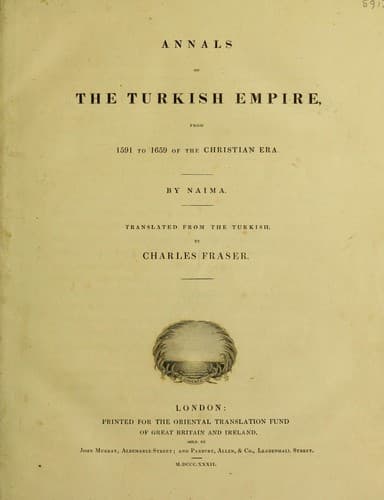
Annals of the Turkish Empire, from 1591 to 1659Naima, Mustafa
History
Annals of the Turkish Empire, from 1591 to 1659
Naima, Mustafa
Turkey -- History -- 1453-1683
means of recalling them to the true faith had been employed, but
were contemptuously rejected; it was therefore proper to attempt
their reduction by force. The Moslem and orthodox army accordingly
advanced and environed Karní Yáruk with the view of laying siege to
it, notwithstanding its immense elevation and great strength. With the
utmost care, and avoiding, as well as possible, the showers of bullets
and arrows which were discharged from the ramparts of the garrison,
they succeeded in mounting so far as to place their standard on its
walls. After employing a whole week in scattering fire and death
among the besieged, the author of the evil began to perceive that all
further resistance would be vain, and, therefore, leaving his wife
and child, threw himself over the wall of the garrison, and made the
best of his way to the sháh. His sons and followers maintained their
resistance for a day or two longer, and then proposed to capitulate.
The orthodox permitted them to retire to any place they chose, and
to take the whole of their property along with them; every Osmánlí
having been prohibited, in the strongest manner, laying a finger on
them, or on their goods, which they were allowed to take along with
them. After this fortress and a few others had been reduced under the
Ottoman power, the troops of Nakhcheván and of Tabríz returned to their
respective homes.
_The Sháh of Persia marches upon Tabríz._
After the Kúrd, Ghází Beg, had made his escape from Karní Yáruk, as
above related, he made his way to the court of Persia, at Ispahan,
where he related the dangers he had undergone and escaped, the success
of the Osmánlís, and earnestly and vehemently urged the Persian
monarch to instant and open hostility against the Turks. He represented
the country of the fire-worshippers, especially the principal city in
it, Tabríz, as abounding with wealth, and that the treasury of it at
that moment was full of money. He said, moreover, that the troops were
very few, if any, and that that was a proper time for pillaging it.
This representation of the Kúrd was all that was necessary for
awakening the cupidity of the perverted sháh, who at once resolved
on reducing the whole of that country under his own authority. This
avaricious sháh, regardless of treaty and common faith, thought of
nothing else but how he might succeed in the attempt. Two or three
thousand of his best troops, Mamlúks, were pushed forward from Ispahan
to Tabríz, by means of caravans, a journey of twenty days, but which
these caravans accomplished in nine, such was the mighty haste they had
made. On the 19th of Rabia II. they erected the standard of hostility
in the plains of Tabríz.
Public-domain text, read in full here on John Shaqi.
Reviews
Reviews
No reviews yet
Be the first to share your thoughts on this work.
Elsewhere in the archive
Join the Discussion
Join the discussion
Sign in to leave a comment or review.
Sign InorCreate an account