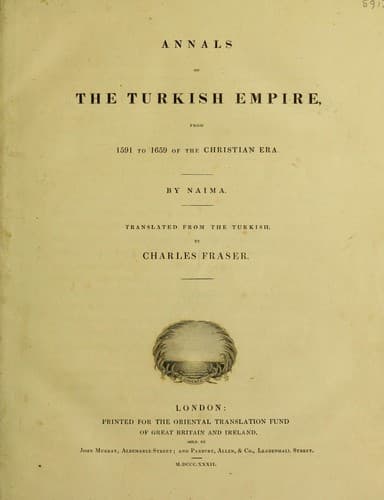
Annals of the Turkish Empire, from 1591 to 1659Naima, Mustafa
History
Annals of the Turkish Empire, from 1591 to 1659
Naima, Mustafa
Turkey -- History -- 1453-1683
prevent the pursuit of the enemy. Such was the result of this terrible
day. Though Hasan had acted throughout with the utmost skill, and had
fought with unequalled bravery; though his military prudence had never
once forsaken him, yet such was the immense superiority of the enemy’s
forces, augmented besides by forty thousand Germans, that it does
not appear surprising that the Moslems were defeated. Eight thousand
Moslems fell or were drowned. The nephew of Rustem Páshá, Mohammed Beg,
and three other Sanjak princes, perished along with Hasan Páshá in the
river at the falling of the bridge. The victorious infidels retired
from the field of battle in triumph.
When intelligence of this unfortunate day reached the court of
Constantinople, the ocean-like zeal of the emperor was stirred up
within him, and at once led him to determine to prosecute the war with
vigour and without delay.
_The Grand Vezír, Sinán Páshá, determines on carrying the war into
Hungary._
The grand vezír, Sinán Páshá, ambitious of acquiring fame similar to
that which Ferhád Páshá, the conqueror of kingdoms, had acquired,
found now a sufficient stimulus to awaken his zeal. The Austrians
having, for the last twelvemonth, neglected sending their accustomed
tribute; the defeat and discomfiture of the veteran Hasan Páshá by the
most consummate general of the enemy, and in which defeat he himself,
Mustafa Páshá, and several other princes, besides many thousand
Moslems, had fallen martyrs, roused the indignation of the vezír, and
at once led him to determine on carrying the war into the Hungarian
dominions. Winter arrived, however, before the vezír had accomplished
the whole of the preparations for the intended expedition, which he had
resolved on conducting in person, and therefore was advised to postpone
his departure till the spring. But the vezír was not to be moved from
the resolution he had formed: none of the considerations which had
been advanced to cause him to put off had the least effect in turning
him from his purpose, and in fifteen days afterwards the whole of his
apparatus was in movement, _i. e._ on the 12th of Shevál, 1001 of the
Hijrah.
Although Sinán Páshá had succeeded, in so short a time, in making the
necessary preparations for the war, yet it was not customary, unless
the emperor himself went forth to war, that the lord high treasurer and
ághá of the Janissaries should go forth; and therefore twelve thousand
Janissaries, destined for the war, were put under the command of a
deputy. Six regiments of paid troops remained behind. The salary of the
troops who were on the eve of marching was paid to them at the vezír’s
palace, and on the 18th of Shevál the grand vezír commenced his march,
leaving behind him Ferhád Páshá as governor of Constantinople.
Public-domain text, read in full here on John Shaqi.
Reviews
Reviews
No reviews yet
Be the first to share your thoughts on this work.
Join the Discussion
Join the discussion
Sign in to leave a comment or review.
Sign InorCreate an account