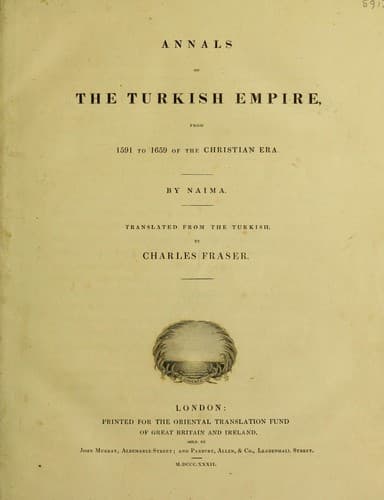
Annals of the Turkish Empire, from 1591 to 1659Naima, Mustafa
History
Annals of the Turkish Empire, from 1591 to 1659
Naima, Mustafa
Turkey -- History -- 1453-1683
Sheikh Muhad ul hamíd wrote a commentary during the time he was
preacher or lecturer in St. Sophia: he was a learned divine. Sheikh
Khezer, the son of a distinguished officer, was a very learned man,
and translated some excellent works. He fell a martyr in the battle of
Agria. Sheikh Shems-ud-dín was a man of such uncommon abstemiousness,
piety, sympathy, and fine feeling, as were not to be imitated. He
exerted himself in the battle of Agria. He translated Imám A’zím’s
system of ethics into Turkish. He is the author of several other
works. Sheikh Mírmírán was very conspicuous for his great temperance
and piety. He was one of those authors who embellished their writings
with drawings. He fell a martyr at the battle of Agria in company with
Beyabáshí Zádeh, and his pure body was not afterwards found. Sheikh
Mahmúd Effendí is noticed in the register of the reign of Murád: he was
a man of great eminence, and was much esteemed by the reigning monarch
in consequence of his political abilities. Sheikh Hasan Effendí was
sheikh in Ibrahím Páshá’s religious establishment: he went on a journey
to Yemen, where he died. Sheikh Váa’z was a man of the first-rate
talents: he was preacher in the mosque of Soleimán; on the days of
assembly he expounded the doctrines of religion to the people, and
immediately after answered and explained difficult questions. He was
strongly opposed to every thing inconsistent with religion, and laid
the severest prohibitions on those who were guilty of transgressing the
precepts of the true faith. Some of the nobles, on account of this very
great strictness, spoke reproachfully of him, and once or twice got him
banished the city; but by the gracious assistance of God he overcame
his enemies, and was again allowed to return to the metropolis.
Sheikh Ismáíl employed himself in the chapel or monastery of Galata
in translating poetry. He left behind him a beautiful paraphrase or
commentary on the Mesnevi, or book of moral doctrines. His seven
published volumes have not escaped the censure of some of the learned;
but it must be acknowledged that he was a man of charming and excellent
qualities. He died in 1012.
Public-domain text, read in full here on John Shaqi.
Reviews
Reviews
No reviews yet
Be the first to share your thoughts on this work.
Elsewhere in the archive
Join the Discussion
Join the discussion
Sign in to leave a comment or review.
Sign InorCreate an account