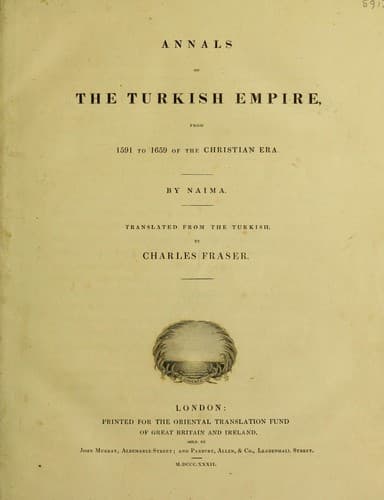
Annals of the Turkish Empire, from 1591 to 1659Naima, Mustafa
History
Annals of the Turkish Empire, from 1591 to 1659
Naima, Mustafa
Turkey -- History -- 1453-1683
Sultán Ahmed Khán ascended the throne of the Ottomans on the 18th of
Rajab, and began his regal authority by a written message to Kásim
Páshá, the káímakám. This written message was folded in a napkin, and
handed to a certain officer, who was desired to deliver it into Kásim’s
own hand. The officer being informed that the message committed to his
charge was a royal one, hastened with all speed, and delivered it to
his excellency the deputy. The deputy, however, found himself unable
to read the communication, and therefore applied to the officer for
information as to the person who sent it. The officer replied that the
ághá of the palace had delivered it to him, and had told him at the
same time it was a royal message. Kásim appeared exceedingly surprised,
and said, the writing wanted the points, and was, therefore, unlike
his majesty’s manner of writing. The letters, continued he, cannot
be deciphered, and of course the meaning cannot be discovered. He
appeared as it were perplexed and confounded at this unaccountable
circumstance, and called Hasan Beg Zádeh to read it to him. Hasan drew
near to the páshá, and read and explained the mysterious document,
which ran thus: “Thou art Kásim Páshá. My father, in the providence
of God, is now no more, and I have ascended the throne of power. You
shall maintain order and good government in the city. If any villany
or wickedness should happen, I shall cut off your head. The conclusion
of the sultán’s words.” Kásim had no sooner heard and understood the
import of the _khati sheríf_, than he became absorbed in grief and
astonishment: so much so, indeed, that many of his friends were led to
think his health was affected; for none, except those in the palace,
knew as yet any thing of the decease of Sultán Mohammed Khán, which
had happened only a few hours before the message had been sent to
Kásim. Kásim, however, thought of a contrivance by which he might know
the utmost of a matter which he had reason to fear presaged no good
to him. Accordingly, he wrote to the ághá of the palace, and stated,
that he, a poor insignificant creature, had just received an imperial
note, the meaning of which, however, he was incapable of discovering.
“Perhaps,” continued the sly and cunning deputy, “it may have been
intended to try us, or it is an intimation that our services are no
longer necessary. In either case, we hope you will have the goodness
to remove our doubts upon the subject.” This note was sent by the same
person who had been the bearer of the imperial edict to himself; and it
was not long before he was called into the chamber of audience, where
he beheld Sultán Ahmed Khán sitting in great splendour on the chair of
state, and who explained to him the meaning of the document which had
alarmed him so much. Kásim Páshá kissed the ground and retired, and the
sultán proceeded to the diván and took his seat on the royal chair. A
messenger was immediately afterwards sent with a note to the mufti,
Public-domain text, read in full here on John Shaqi.
Reviews
Reviews
No reviews yet
Be the first to share your thoughts on this work.
Elsewhere in the archive
Join the Discussion
Join the discussion
Sign in to leave a comment or review.
Sign InorCreate an account