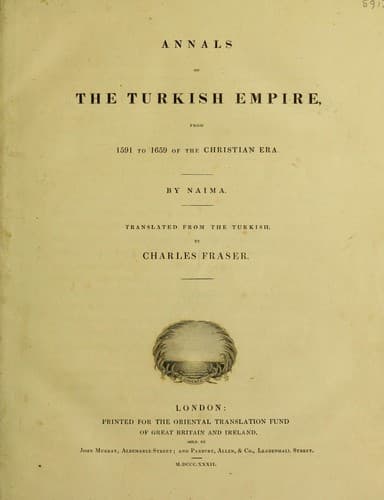
Annals of the Turkish Empire, from 1591 to 1659Naima, Mustafa
History
Annals of the Turkish Empire, from 1591 to 1659
Naima, Mustafa
Turkey -- History -- 1453-1683
The ambitious Kásim Páshá sought to ingratiate himself into the favour
of the new emperor, and desired to be called into his presence. His
efforts, however, not only failed, but terminated in a prohibition of
his approaching his sacred majesty on any account whatever. Once more
despair became his companion; he however found courage and confidence
to try his fortune once more. Having neglected or forgotten on the
day of inauguration to show respect to Mustafa Effendí, the emperor’s
spiritual guide, and hearing that he was held in great estimation
by his master, he sent a deputation to him with splendid gifts and
presents, with the view of gaining his good offices in his behalf; but
he was again thwarted. Alí Páshá, _i. e._ Yávuz Alí Páshá, the grand
vezír, who was now in power, and possessed great influence in his
majesty’s counsels, was the person who caused Kásim Páshá’s removal and
banishment from court altogether.
_The arrival of the fleet.—Concerning the grand vezír, Yávuz Alí Páshá._
It so happened that the very day on which his majesty’s inauguration
was performed the royal fleet arrived from the Mediterranean, and the
admiral, Jeghala Zádeh Sinán Páshá, had the honour of kissing the new
emperor’s hand. The admiral, by that imperial command, was decorated
with a robe of honour.
Yávuz Alí Páshá had been recalled from Egypt with the view of being
raised to the premiership; and though the seals of office had been
actually sent to him when it was known that he had arrived in Turkey,
yet he did not reach Constantinople till the 25th of Rajab. On arriving
there he waited on his royal master, and afterwards went to the royal
diván where he took his seat in it. The vezírs and the military
judges also attended, and sat in their respective places. To the new
minister was committed the distribution of the emperor’s munificence
on his exaltation to the throne of his fathers, and he, it must be
observed, brought with him from Egypt two years’ arrears of taxes;
a circumstance, no doubt, which rendered it more easy for him to be
liberal than perhaps he otherwise could have been. Seven hundred
thousand pieces of gold were accordingly taken from the royal treasury,
and sent to the various troops throughout the empire. This fact alone
was a sufficient indication of the wide extent of the pecuniary
resources of the Ottoman government, and may well excite surprise:
but the fact is certain, and Alí Páshá, by whose means this handsome,
but vast sum, was allotted for the use of the military and naval
services, had no sooner made the necessary arrangements respecting its
distribution, than he dressed himself in his ministerial robes, and
went to the palace of Siávush Páshá to hold a council. Hereupon Kásim
Páshá, the káímakám and second vezír, and Kúrd Páshá, third vezír,
by virtue of their offices, entered and took their seats. The result
of the deliberations of the council (at which Alí Páshá, the grand
Public-domain text, read in full here on John Shaqi.
Reviews
Reviews
No reviews yet
Be the first to share your thoughts on this work.
Elsewhere in the archive
Join the Discussion
Join the discussion
Sign in to leave a comment or review.
Sign InorCreate an account