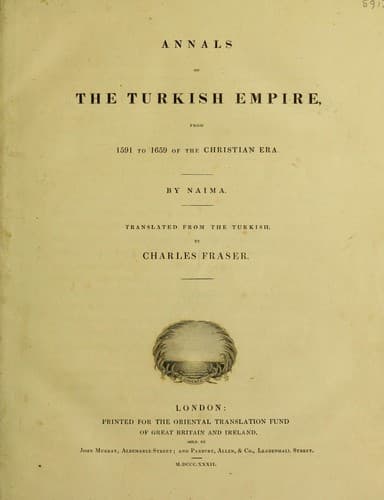
Annals of the Turkish Empire, from 1591 to 1659Naima, Mustafa
History
Annals of the Turkish Empire, from 1591 to 1659
Naima, Mustafa
Turkey -- History -- 1453-1683
informing him of what had happened at the palace, and orders were
issued also to the ághá of the artificers to get a royal bier prepared;
the nobles and grandees of the state were invited to assemble. The
servants of the diván, when they saw the preparations that were going
forward, supposed Sultán Mohammed Khán was coming forth, and that all
the arrangements which had been made, and were making, were on his
account. It was no such thing. A throne was erected, but it was not for
him. Their eyes, however, were soon opened to the whole secret. The
mufti, Mustafa Effendí, arrived, and proceeded along under the golden
arch, accompanied by all the vezírs, until he and they reached the foot
of a throne, which had purposely been erected for the occasion. The
young prince, dressed in mourning, advanced towards them and saluted
them; then approached the throne, and desired he might be inaugurated
thereon. The Chávushes immediately raised their voices, and sounded
his praises to the third heaven. Silence being again obtained, the
reverend mufti, the vezírs, and all the other dignitaries, approached
him and congratulated the new emperor. This ceremony ended, the emperor
made his saláms and retired; the throne which had been erected was
removed, and shortly afterwards all the vezírs, ulemá, and great men,
were supplied with black crape for their turbans; but such as were
not furnished with this emblem of sorrow and respect for the deceased
monarch, put black bands on their arms. All now waited without at the
gate of the mansion of felicity for the appearance of the remains of
Sultán Mohammed Khán.
At this time, notwithstanding the delicacy, as well as solemnity, of
the occasion, Kásim Páshá could not hide the ambition which filled his
breast. His eye and heart were on the grand vezírship, and without
incurring the risk of delay, he tried to persuade the reverend mufti to
sound his majesty on this point. The project, however, did not succeed.
The royal remains, after having been put into a coffin, were brought
forth, and the reverend mufti performed the funeral ceremonies,
according to custom. Ahmed, the new emperor, retired within the palace;
and the vezírs and great men accompanied the royal bier to St. Sophia,
where the corpse was interred in the royal sepulchre. Provisions were
distributed amongst the poor and orphans in the city, for the benefit
of the soul of the deceased, and other acts of charity were performed
with the same view.
Public-domain text, read in full here on John Shaqi.
Reviews
Reviews
No reviews yet
Be the first to share your thoughts on this work.
Elsewhere in the archive
Join the Discussion
Join the discussion
Sign in to leave a comment or review.
Sign InorCreate an account