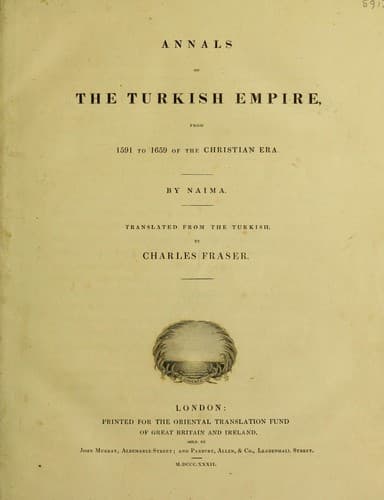
Annals of the Turkish Empire, from 1591 to 1659Naima, Mustafa
History
Annals of the Turkish Empire, from 1591 to 1659
Naima, Mustafa
Turkey -- History -- 1453-1683
On the 16th of Dhu’l hijja he passed over to Scutari, as we have
already observed; and on the 17th he commenced his march with such
troops as were there waiting for him, and which were composed of
various kinds. On reaching Nicomedia (in Bythinia) the feudatory troops
which composed his right wing began to represent that they belonged,
properly, to the army of Romeili, and asked if they were to be paid
wages if they continued in conjunction with the army of Anatolia. A
firmán was immediately issued which assured them that they should. On
arriving on the confines of Erzerúm, he was joined by the followers
of the late Delí Hasan, along with their leader Karah Kásh Ahmed, who
all swore fealty to the Ottoman government, pretending at least to
have repented of their misconduct and rebellion. In a few days more
he was joined by several others, particularly by the beglerbeg of
Erzerúm, Gusháh Sefer (a very brave man, and remarkably well skilled
in horsemanship, who was raised to dignity and honour from the humble
situation of serving in the imperial kitchen) with four thousand men,
well armed, whom he had collected in the greatest haste. The active
Ahmed Páshá, beglerbeg of Wán, with three or four thousand veterans,
met the grand army in the plains of Pas. On the 15th of Jemadi II., the
whole of the Moslem army reached Kurus, when they halted for ten days,
in order to give time for other troops to join the royal standard,
and for the return of Karah Kásh Ahmed, who had been sent out on a
depredatory excursion.
Sháh Abbás, when he heard of the advance of the Osmánlís, removed his
troops from Reván and from Akcha Kalla, where they had been posted, and
retreated. This information had no sooner reached the Moslem camp, than
Sefer Páshá addressed the commander-in-chief for permission to advance
with a party of veterans and intercept the sháh in his retreat. “His
army was comparatively small,” said Sefer, “and if you advance with the
grand army in the ordinary way, to my support, I am not without hopes,
if you agree to my proposal, of being able to bring the sháh bound in
fetters before you.” Such was the heroic language of Sefer Páshá, but
the serdár was deaf to all his entreaties. He pretended to be waiting
for the arrival of Karah Kásh; and even when Karah Kásh did arrive, he
was as far as ever from complying with Sefer Páshá’s proposal. Thus,
by delay and hesitation, the enemy was not only allowed to withdraw to
a greater distance, but had time afforded them for preparing to offer
a more formidable resistance; whilst the grand army by this procedure,
was exposed to greater danger, to more difficulties, and to a less
chance of success.
Public-domain text, read in full here on John Shaqi.
Reviews
Reviews
No reviews yet
Be the first to share your thoughts on this work.
Elsewhere in the archive
Join the Discussion
Join the discussion
Sign in to leave a comment or review.
Sign InorCreate an account