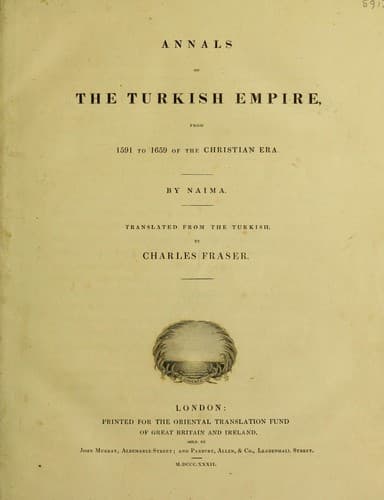
Annals of the Turkish Empire, from 1591 to 1659Naima, Mustafa
History
Annals of the Turkish Empire, from 1591 to 1659
Naima, Mustafa
Turkey -- History -- 1453-1683
The commander-in-chief was indeed at length roused to some activity;
but it was only when he perceived the season for warlike operations
fast passing away, without his having gained one single advantage,
that he was thus roused. Without paying any regard to the councils of
Sefer Páshá, which might have been attended with glorious results,
had he allowed himself to be swayed by them, he again commenced his
march in pursuit of the retreating enemy, and even sent letters to
the sháh offering him battle, but the wary sháh paid no regard to
his invitations. By the time the grand army reached Nakhcheván, the
sháh and his army had safely got into the jurisdiction of Tabríz.
The commander-in-chief now saw his error, but it was too late to
correct it; and he was destined, in consequence of his own tardiness
and want of skill, to become more pre-eminently the sport of fortune.
The country round Nakhcheván had been, a little before, the theatre
of rebellion and of devastation; and in consequence of this, the
cities and villages were enduring the greatest calamity from famine,
at the time the Moslem army arrived in Nakhcheván. The serdár, when
he perceived the dismal condition he and his army were in, proposed
marching towards Shirván, where his son, Mahmúd Páshá, was beglerbeg.
The chiefs of the army appeared before the serdár, and told him
he might do what he liked, and take what journey he pleased, but
the heretics were not to be overtaken. It was quite impracticable,
they said, to follow them with a large army; nor would it prove any
advantage, they further observed, to march against Tabríz and lay
siege to it. The season for retiring into winter-quarters was just at
hand, and they therefore thought it would be more prudent to return
to their own country. The serdár was totally averse to this proposal,
and endeavoured to dissuade them from urging this measure. He did so
by representing to them how desirable it was to terminate the campaign
honourably; that there still remained a chance of their succeeding;
and that it would be much more wise, under all circumstances, to take
up their winter-quarters in Gunjah and in Karabágh, than to return to
Turkey before they had accomplished something worthy of their name.
This speech had the desired effect: the troops struck their tents, and
marched forward towards Tabríz. After having passed the river Ars,
and accomplished a few stages, they learned that they were within a
stage or two of coming up with the sháh, who was retreating with all
his might before them. Sefer Páshá, Ahmed Páshá, beglerbeg of Sivás,
and Alasha Atlí Hasan Páshá, earnestly implored the commander-in-chief
to be allowed to proceed with a body of light troops and overtake the
sháh, but he again refused to grant them their request, and maintained
his usual obstinacy. On reaching Wán, he distributed his troops into
different cantonments, but he himself remained at Wán for the winter.
Public-domain text, read in full here on John Shaqi.
Reviews
Reviews
No reviews yet
Be the first to share your thoughts on this work.
Elsewhere in the archive
Join the Discussion
Join the discussion
Sign in to leave a comment or review.
Sign InorCreate an account