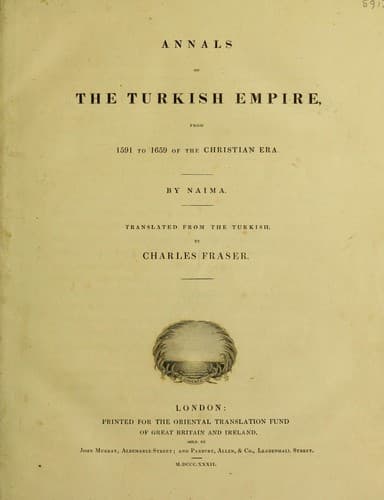
Annals of the Turkish Empire, from 1591 to 1659Naima, Mustafa
History
Annals of the Turkish Empire, from 1591 to 1659
Naima, Mustafa
Turkey -- History -- 1453-1683
The speaker, it may be observed in passing, had himself some thoughts
of throwing off the German yoke some time before this, and it was for a
rumour of this kind which had reached the ear of the emperor of Austria
that he had been imprisoned; but as no sufficient evidence of this his
intention had been produced, he was set at liberty. But to return.
Botchkai replied that the inhabitants of the country were in general
Christians, and would not on that very account humble themselves so
far as to put themselves under the Turks. “Why,” said the ex-emir,
“they did so in the days of Soleimán, and it was well with them. Why
not do it at this time?” After having conversed for some time on this
subject, Botchkai yielded to the advice of his adviser and sent him to
the vezír; who was introduced to his excellency by Mohammed Páshá’s
nephew, at that time interpreter to Bektásh Páshá. He spent a few days
in secret consultation with his excellency, to whom he explained the
object of his mission, and then returned. But it was not till after
three or four such interviews were held and a contract entered into,
that Botchkai unfurled the standard of rebellion against the emperor
of Austria. It was not, moreover, till Botchkai had completely subdued
the whole of the German fortresses on both sides of the river Tise
(Tibiscus), that he came forward to seek that aid from the Muselmans
which, no doubt, had been promised him.
The emperor of Austria was no sooner apprized of Botchkai’s revolt,
than he sent a person of the name of Báshtái Yúrkí with German forces
to chastise the rebel; but the former were totally defeated in the
very first engagement. Botchkai, in the meantime, having received a
reinforcement of Tátár and Temiswar troops from the grand vezír, his
courage was amazingly increased, and he followed up his victory with
rapidity and zeal. Every town and village which owned subjection to
the German despot he exposed to all the horrors of war and rapine, and
returned with immense booty, and joined the Moslem army in the capacity
of a vassal of the Ottoman empire.
The promise which the vezír had made to obtain for him the royalty of
Hungary (not of Transylvania, as before mentioned) he also punctually
fulfilled after he returned to Constantinople, as we shall afterwards
see. Gúzelcheh Mahmúd Páshá, who, in consequence of the part he had
acted in the tumult which had taken place in the affair of Yemishjí
Hasan Páshá, as formerly mentioned, had fled in disguise, and had lived
all this interval in a sort of monastery or cell belonging to some
Súfis, received his majesty’s pardon, was raised to the dignity of his
former vezírship, and afterwards married Ayesha Sultána, the widow
of the late Yemishjí Hasan Páshá, for whom he paid a dowry of four
thousand akchas (pieces of money).
_Concerning the defeat of Kásim Páshá._
Public-domain text, read in full here on John Shaqi.
Reviews
Reviews
No reviews yet
Be the first to share your thoughts on this work.
Elsewhere in the archive
Join the Discussion
Join the discussion
Sign in to leave a comment or review.
Sign InorCreate an account