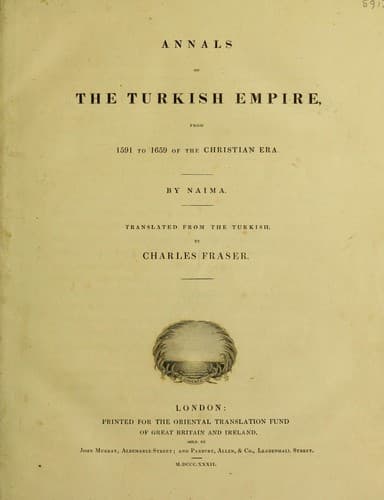
Annals of the Turkish Empire, from 1591 to 1659Naima, Mustafa
History
Annals of the Turkish Empire, from 1591 to 1659
Naima, Mustafa
Turkey -- History -- 1453-1683
We noticed sometime ago, that Kásim Páshá, on the 22d of Rabia
II., had been appointed to the government of Baghdád. We referred
particularly also to his conduct towards Alí Páshá, and to the tyranny
and oppression he had exercised at Scutari. In the neighbourhood of
Brúsa, whither he had gone after leaving, or rather after he was
obliged to leave Scutari, he committed the same kind of shameless
excesses he had been guilty of in other places. Complaints against his
cruelty and tyranny having been laid before the emperor, a bostánjí
báshí was forthwith dispatched with orders to cut him off, but who
was so overawed by the páshá that he had not the resolution to fulfil
his mission. The grand vezír, because he did not obey the order of
government, removed the bostánjí báshí from his office, and appointed
Dervísh Aghá, ketkhodá of the bostánjís, in his stead. This is the same
Dervísh Aghá who afterwards obtained a near access to the emperor’s
ear, and was made páshá for the important services he had rendered
to the state. But to proceed. Kásim Páshá not only escaped the snare
which had been laid for him, and the death he ought to have suffered,
but was actually appointed to the government of Kutahia. Here he also
manifested a spirit of carelessness and indifference, which eventually
entailed upon him the punishment which had formerly been meditated
against him. In order, however, to make sure of this, it was considered
wise to send him a royal letter appointing him to the deputyship of
Constantinople, in room of Háfiz Páshá, and an invitation to him to
return and take possession of that office. Confiding in the royal
letter Kásim returned to Constantinople, and was hardly one day in
office, when he received three royal communications on important
affairs, which, at once, had the effect of clearing away all doubt from
his mind as to his being firmly fixed in the deputyship. This being
the case, as he believed, he that very day appointed his predecessor
Háfiz Páshá, third vezír. Ibrahím Aghá he made master of the horse,
and Mím Ibrahím his remembrancer. About supper-time Chobán Soleimán,
chief of the royal messengers, waited upon the new deputy, and informed
him that on the following morning a council was to be held in the
royal presence; and also that the emperor’s chaplain, the mufti, the
vezírs, and other magnates of the state, had all been invited to
attend. Accordingly, at daybreak next morning Kásim Páshá proceeded
to the diván with great pomp and ceremony. On entering into the royal
presence, and before all who were present, he advanced towards the
emperor and did obeisance. The emperor, without any sort of preamble,
began immediately to question him with respect to his conduct in
neglecting to obey his royal mandates on more occasions than one. Kásim
was confounded, and could find nothing to say in reply: to vindicate
himself was impossible. The emperor then turned to the high-priest
Public-domain text, read in full here on John Shaqi.
Reviews
Reviews
No reviews yet
Be the first to share your thoughts on this work.
Elsewhere in the archive
Join the Discussion
Join the discussion
Sign in to leave a comment or review.
Sign InorCreate an account