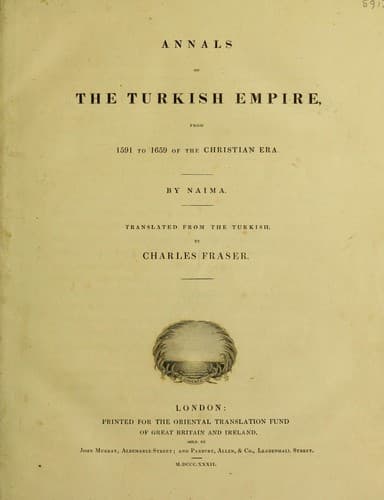
Annals of the Turkish Empire, from 1591 to 1659Naima, Mustafa
History
Annals of the Turkish Empire, from 1591 to 1659
Naima, Mustafa
Turkey -- History -- 1453-1683
When the grand vezír, Lálá Mohammed Páshá, returned, last year, to
Constantinople, he did not forget to lay before his royal master a
statement of the promise or engagements he, as the organ of the Ottoman
government, had entered into with Botchkai; the result of which was
a splendid crown, valued at three thousand ducats, and, moreover,
richly studded with precious stones, for Botchkai. One Seyed Mohammed
was sent to Botchkai from the commanding general, to inform him of
what was going on in his favour, and to invite him to wait upon him.
The commanding general, who at this time was encamped near Pest, no
sooner heard of the near approach of Botchkai, who, in obedience to
the invitation sent him, was coming to wait on him, than he ordered a
splendid royal pavilion, handsomely adorned with fine curtains, to be
erected for his royal visitor. The whole of the troops were ordered to
stand under arms, and in proper order to receive him. The flooring of
the pavilion was made of precious odoriferous wood or planks; and, in
short, every thing suitable to the dignity of the approaching monarch
was punctually attended to. At length Botchkai, attended by a guard of
ten thousand Hungarians, besides many distinguished princes, arrived
in the Moslem camp, and went immediately to pay his respects to the
commanding general. The splendid and highly valuable crown, above
referred to, was brought forth and placed on his head by the hands of
the general. A richly-ornamented sword was presented him on the same
occasion: and immediately afterwards he was declared to be raised,
by Ottoman imperial munificence, to the sovereignty of Hungary. The
banners and standards, which the Ottoman government condescended to
send him, were presented to him in due form. Botchkai made all due
acknowledgment for the dignity and honour conferred on him, kissed the
commanding general’s hand, and said: “We are now become the emperor’s
servants. Those who are hired with money, serve generally out of fear
of reproach or of punishment; but we, inasmuch as we are favoured
servants, still manifest the most genuine and cheerful obedience.”
Thus, the contract first made with Botchkai was fully ratified and
signed; the field-pieces in the camp were fired in token of joy; great
demonstrations of heartfelt pleasure were every where, throughout
the camp, instituted, and cheerfully observed; and Botchkai, now
created king of Hungary, took leave of his friends and returned to his
newly-acquired dominions.
Botchkai, after he was advanced to the rank and dignity of a sovereign
prince, contributed very much to the welfare of the Moslem religion. So
much so, indeed, that the infidel Germans, who were filled with hatred
against him, when they found it impossible to take him in open battle,
endeavoured by every means they could devise to poison him, which at
last they accomplished.
Public-domain text, read in full here on John Shaqi.
Reviews
Reviews
No reviews yet
Be the first to share your thoughts on this work.
Elsewhere in the archive
Join the Discussion
Join the discussion
Sign in to leave a comment or review.
Sign InorCreate an account