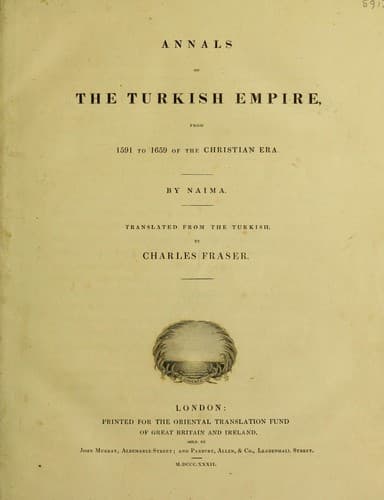
Annals of the Turkish Empire, from 1591 to 1659Naima, Mustafa
History
Annals of the Turkish Empire, from 1591 to 1659
Naima, Mustafa
Turkey -- History -- 1453-1683
When tidings of the death of Botchkai reached the Sublime Porte, the
government proceeded to make choice of another of the Transylvanian
princes to succeed him in the sovereignty of Transylvania,[16] and
Batori Ghabor was the one who was elevated to that dignity. The
elevation of Batori Ghabor, as now hinted, had the effect of widening
the breach between Turkey and Austria, but it eventually led to the
latter’s negociating for peace.
The commanding general, who unfortunately became indisposed, remained
a few days in Buda arranging and settling matters with his servants,
appointed the celebrated hero Hasan Páshá, beglerbeg of Romeili,
commandant of Buda, and set out for Belgrade. On reaching this city, he
paid off the troops, and allowed them to return to their own provinces;
but he himself spent the winter there, where he enjoyed all the
pleasures of life.
The Moslem army, by the assistance of God, achieved this year the
advantages and triumph which they sought. This one campaign brought
them more glory than any one of the preceding twelve. In fact, the
Moslems accomplished more this year than they had done in all the
others put together: so wonderfully successful had they been. The
wealth they had acquired was altogether unprecedented in the history of
their wars with the northern infidels.
The exalted commanding general, after having gone to Belgrade, as
before mentioned, procured double pay for the troops. Petcheví Ibrahím
Effendí was appointed to see the distribution properly attended to.
_Peace is proposed by the Archduke Mathias._
Botchkai, of whom we have had a great deal to say, vexed and distressed
the Austrians to the very utmost; which at last had the effect of
inducing the Archduke Mathias, who was at that time in Vienna, when he
perceived the danger which threatened to subvert from him the whole of
his dominions, to send an embassy to the Moslem commander-in-chief. He
clearly saw that his troops were not able to resist the superior force
of the Ottomans, or withstand the powerful and vigorous hostility of
Botchkai. His only army in Transylvania also was on the very point of
being surrounded. When made aware of all these alarming circumstances,
he sent the embassy alluded to, and, at the same time, informed the
emperor his brother, who was at Prague, the capital of Bohemia, of what
he had done. He stated in his communications to the emperor, that if a
treaty of peace was not agreed upon he should by degrees be stripped
of all his dominions in Hungary. “Part of them would fall,” he said,
“under the Turks, and the rest would be trampled under the feet of
Transylvanian cavalry.” The emperor, well aware that peace was every
way desirable, expressed his approbation of the steps Mathias had taken
to bring about so very requisite an object.
Public-domain text, read in full here on John Shaqi.
Reviews
Reviews
No reviews yet
Be the first to share your thoughts on this work.
Elsewhere in the archive
Join the Discussion
Join the discussion
Sign in to leave a comment or review.
Sign InorCreate an account