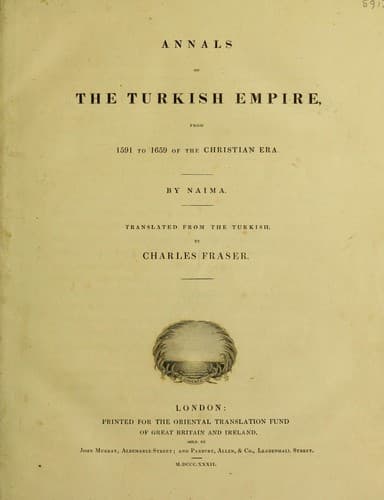
Annals of the Turkish Empire, from 1591 to 1659Naima, Mustafa
History
Annals of the Turkish Empire, from 1591 to 1659
Naima, Mustafa
Turkey -- History -- 1453-1683
The emperor, however, in conformity to the principles of his vain
religion, applied to the ungracious Pope of Rome for his advice, who
expressed himself altogether hostile to the measure proposed. This
audacious pope[17] had the hardihood and wickedness to write back to
the emperor, desiring him to get his brother to withdraw the proposals
he had made, or if he refused to do so, to kill him. Such was the
advice of the pope.
The emperor informed his brother of the sentiments which his holiness
had expressed, and urged him in the strongest manner to pay implicit
regard to them: assured him, moreover, that it was of much more
consequence to him to have the prince of religion on his side, than any
relative, however near to him; and therefore conjured him to continue
the war. Mathias replied, that it was of the utmost moment to him to
have peace on any terms; that preliminaries had been entered into, and
that he was determined not to recede.
In the meantime Mathias collected what Hungarian and Transylvanian
forces he was able, who, when united with the troops he had sent to
protect his Transylvanian dominions, formed a very considerable army.
With this army he purposed advancing upon Prague, but the death of the
emperor,[18] which happened at this time, put a stop to this warlike
attempt.
The death of the emperor changed the aspect of affairs in relation
to Mathias altogether, and bound him, in consequence of the law of
succession, to respect the unworthy injunctions of the pope. This pope,
to reproach and mortify Mathias for having offered conditions of peace
to the Turks, raised Maximilian, a younger brother, an infidel, to the
imperial dignity, to the exclusion of the lawful heir. It was that very
same Maximilian, who, with his 70,000 infidels, was defeated before
Agria by the heroic Sultán Ahmed Khán; that same Maximilian who hardly
escaped from the scene of action with his life; who, unable to mount
his horse or gird on his sword, fled away on foot; who, preferring a
monastic life, ran off to the pope and entered into a monastery; it
was that very same Maximilian whom the pope, in the plentitude of his
power, and in the bitterness of his wrath, nominated to fill the throne
of the Roman emperors, and whom he sent into Hungary. Mathias, however,
prepared to dispute his pretensions, and with the army he had led, or
had intended to lead against his deceased brother, he stood ready to
meet this Maximilian. But Maximilian’s courage failed him, and Mathias,
without striking a blow, ascended the throne of the Cæsars. Maximilian
being now unable to promote the pope’s purposes, was appointed to the
government of Vienna, and Mathias repaired to Prague, the imperial
city, and commenced the exercise of his imperial prerogatives.
Public-domain text, read in full here on John Shaqi.
Reviews
Reviews
No reviews yet
Be the first to share your thoughts on this work.
Elsewhere in the archive
Join the Discussion
Join the discussion
Sign in to leave a comment or review.
Sign InorCreate an account