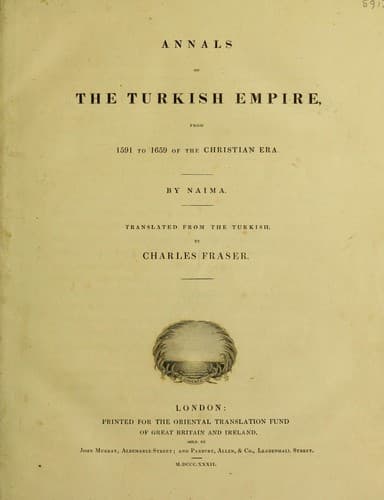
Annals of the Turkish Empire, from 1591 to 1659Naima, Mustafa
History
Annals of the Turkish Empire, from 1591 to 1659
Naima, Mustafa
Turkey -- History -- 1453-1683
It turned out, however, that the Kizilbásh army, supported by the
sháh’s body-guard, resolved on attacking the commanding general’s camp,
which, they supposed, was left without any to defend it. But these
dogs were met by a body of janissaries, salihdárs, and others, who
stood ready to receive them, and who, with their arrows and small arms,
drove them back. The contest, however, was obstinate, and maintained
till sun-set, when the despicable wretches, after seeing many of their
number wounded and perishing on the field of battle, fled back to their
encampments. But Sefer Páshá, who was returning from the scene where
he had performed so many and such wonderful exploits, met this horde
as they were flying from the face of the Moslems, who had opposed
and repulsed them just a little before, and fell upon him and his
heroic followers. He and his party, of course, were much fatigued by
their late exertions, which had been crowned with the most singular
success; whilst the enemy, who thus attacked them, were comparatively
fresh, and consequently it was not to be wondered at if they declined
accepting a battle. This they did not altogether avoid, though a number
of them, among whom was Tekelí Páshá, Jelalí Karah Kásh Páshá, and
Kechkár Páshá, with their respective followers, fled to the camp and
escaped; whilst their companions fought till they fell martyrs on the
field. In this bloody contest, Sefer Páshá, the hero of the party, and
whose weapon nothing could resist, was at last wounded, and shortly
afterwards his horse fell with him. Some of the Kizilbáshes seized him
and several other wounded veterans, and dragged them before the sháh,
who ordered some of them to be killed, and to reserve the others. To
Sefer Páshá he said, “if you will submit to me, and join our sect
(_i.e._ the sect of Alí), I shall confer honour upon you.” The firm
Moslem replied, by wishing “a thousand curses to fall upon him and upon
every heretic of his sect.” The prisoner, who was bound to a stake, and
exhibited to the view of the multitude, loaded the heretical sháh with
every species of reproach and contumely, when immediately some of the
vagabond red-heads rushed upon him and slew him. Thus ended this brave
man. It is true that the commanding officer sent more than once to
dissuade him and his rash companions from their precipitate measures,
but it is also true that Sefer Páshá, though a very brave man, was yet
very obstinate and contumacious. Karah Kásh, and some others of his
desperate followers, disregarding all subordination, resolved on being
revenged on their enemies.
Public-domain text, read in full here on John Shaqi.
Reviews
Reviews
No reviews yet
Be the first to share your thoughts on this work.
Elsewhere in the archive
Join the Discussion
Join the discussion
Sign in to leave a comment or review.
Sign InorCreate an account