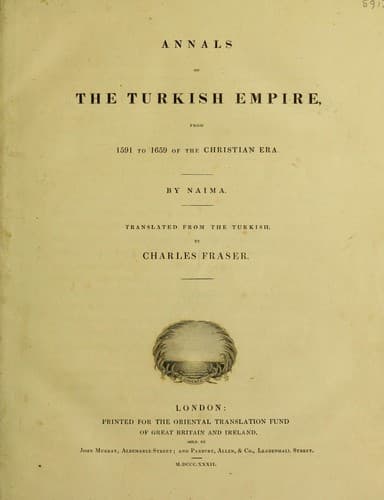
Annals of the Turkish Empire, from 1591 to 1659Naima, Mustafa
History
Annals of the Turkish Empire, from 1591 to 1659
Naima, Mustafa
Turkey -- History -- 1453-1683
It is remarkable, and indeed it is one of the inscrutable ways of
Providence, that those who fell in these various skirmishes were for
the most part those levends or volunteers who had been very lately
engaged in rebellion against the Ottomans. It rarely happened,
throughout the whole of these struggles, that any of the sworn and
paid troops fell. The Moslem army, generally, suffered no injury. But
these levends, in God’s distribution of justice, were made to expiate
their former crimes and villany by making them wash their filth in this
bloody fountain.—But to return.
The carnage to which we have above alluded was put a stop to by
the return of night, when the contending parties were under the
necessity of retiring. The Kizilbáshes, however, retreated, but the
commander-in-chief maintained his ground, or at least he remained where
he was (for it does not appear that he had any personal share in the
actions which had taken place). During the night season the chiefs
and nobles of Kúrdistán came to wait on the commander-in-chief, with
the view of consulting with him as to the circumstances in which they
were then placed, and of the probable result of their movements and
operations; but they were refused admittance, and were told that the
commanding general was fatigued and could not see them. The chiefs
returned to their own camp; but it soon began to be circulated that
the commanding general had fled, and therefore the Kurds, when they
heard this, struck their tents, and were on the eve of retiring, when
Karah Kásh struck his tents also. The rest of these auxiliary native
troops followed the example set before them, and the whole body of
them set out for Wán. Jánbulát Zádeh Hasan Páshá, beglerbeg of Aleppo,
was returning from the field of battle, where he had also been engaged
the day before, when he met these fugitives, who informed him, though
falsely, that the power of the commander-in-chief was completely
broken. Believing that what they had assured him of was true, he
returned; but learning afterwards that he had been deceived by them, he
directed his steps towards the Moslem camp. To prevent, if possible,
these fugitives occasioning any loss to the Moslem army, he from these
disinterested views changed his mind, joined them, and went to Wán
along with them.
Public-domain text, read in full here on John Shaqi.
Reviews
Reviews
No reviews yet
Be the first to share your thoughts on this work.
Elsewhere in the archive
Join the Discussion
Join the discussion
Sign in to leave a comment or review.
Sign InorCreate an account