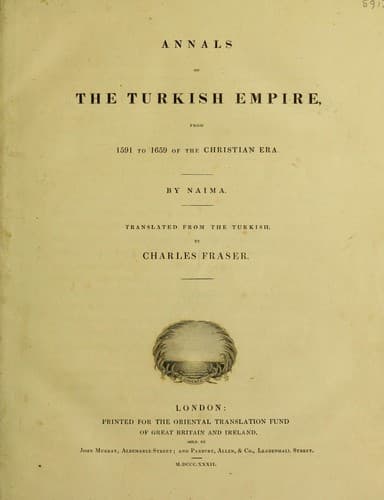
Annals of the Turkish Empire, from 1591 to 1659 — John Shaqi
Annals of the Turkish Empire, from 1591 to 1659Naima, Mustafa
History
Annals of the Turkish Empire, from 1591 to 1659
Naima, Mustafa
Turkey -- History -- 1453-1683
Naima commences his history of the Turkish empire with the year of the
Hijrah or Hejeret 1000 (A.D. 1591), and brings it down to the year 1070
of the same era. This work was probably intended by its author to form
the supplement or continuation of the history composed by Sa’d-úd-dín,
which commences with the origin of the Turkish power, and brings down
the narrative of events to 926 (A.D. 1526).
Naima’s Annals consist of two large volumes folio, which were printed
at Constantinople in the year of the Hijrah 1147, being the twelfth
printed work which issued from the imperial press of Constantinople.
In six years afterwards, Ráshid’s History, and the Annals of Chelebí
Zádeh, followed, having issued from the same press, and are a
continuation of Naima.
Of Naima himself we have not been able to collect any certain
information; nor do we know at what period he lived: but we conjecture
he must have been contemporary, or nearly so, with Kátib Chelebí,[1]
author of the Fezliké, to which work Naima sometimes refers. As a
narrator of facts, however, we think, from what we have read of
him, we have just cause to accuse him of partiality and occasional
exaggeration, into which the historian ought never to be betrayed. But
where, we would venture to ask, is there one of this class of writers
who stands entirely acquitted of these defects? To a Turk, however,
the Annals of Naima possess that same sort of importance which we, in
similar circumstances, are accustomed to attach to a work of the like
nature amongst ourselves. The Turk, we have no doubt, will consider,
as sound doctrine, the defects to which we have referred, and that
too without hesitation and without enquiry; because they are entirely
congenial to his creed and modes of thinking.
Of the annexed translation we have only one word to say, and that is,
that we have exercised all possible care to translate honestly and
fairly, and this being all we undertook to accomplish, we leave it to
speak for itself.
THE TRANSLATOR.
_Edinburgh, May 24th 1832._
N.B.—In the following work the system of Sir William Jones, in the
orthography of Oriental words, has been used as far as the nature of
the Turkish language would permit. The accented vowels have the same
sounds as in Italian; and the unaccented, the short sounds, as _a_ in
_bat_, _i_ in _lily_, &c. The consonants have the sound usually given
them in our own language.
AUTHOR’S PREFACE.
IN THE NAME OF THE MOST MERCIFUL AND MOST GRACIOUS GOD!
The thousandth year of the Hijrah commenced on the first of
Moharrem—which is also the Sabbath-day (Saturday)—and is the three
hundred and fifty-fourth thousand four hundred and ninety-ninth day of
the Prophet’s flight.
Public-domain text, read in full here on John Shaqi.
Reviews
Reviews
No reviews yet
Be the first to share your thoughts on this work.
Join the Discussion
Join the discussion
Sign in to leave a comment or review.
Sign InorCreate an account