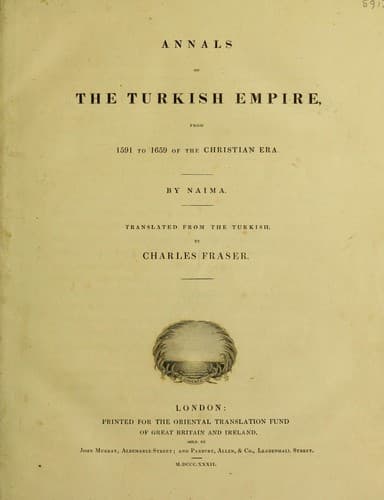
Annals of the Turkish Empire, from 1591 to 1659Naima, Mustafa
History
Annals of the Turkish Empire, from 1591 to 1659
Naima, Mustafa
Turkey -- History -- 1453-1683
In the meantime the enemy concentrated in the vicinity of Wáj, and
after very much fighting reduced the fortress of Novograde. About the
same time, also, some of the chiefs of Wáj failed in their courage
and fled, when a troop of infidels came and set fire to the suburbs,
and carried off what plunder they were able. On the 19th of Jemadi
II., when the sound of the cannon ceased to be any more heard from
Novograde, the Wajian chiefs, excited by curiosity, ran towards evening
to Novograde, to see how matters stood there, and were sufficiently
confounded when they saw the enemy rushing from all directions into
the place, distressing the inhabitants, thrusting them forth naked
and disgraced, and committing every sort of violence on these poor
creatures. When these naked wretches, thus thrust out of Novograde,
met the Wajian chiefs, they warned them of their danger. “Watch your
villages and city,” said they, “the infidels will soon be at your
heels. What do you want here? What are you gazing at? Have you not
sufficient example in our fate?” The Wajian chiefs took the hint, and
fled to Buda. Nevertheless, the governor of Wáj and four or five of
his men had the courage to remain behind. The fortress of Sunta was
afterwards burned to the ground by order of Hasan Páshá. Several of
the Novogradians came to seek a retreat in the city of Wáj before its
suburbs were burned by the enemy, but they were robbed and spoiled,
even of their geese and hens, on that occasion of rapine and plunder.
A party of horsemen came and surrounded Wáj, but the desperate
inhabitants of the inner fortress were so excited at the conduct and
rage of the infidels, that they exerted every nerve in self-defence,
and by their heroic bravery dispersed their antagonists from their
gates, many of whom went away wounded. The whole party afterwards
returned to Novograde.
_The Faithless are chastised._
Mohammed Páshá, son of the grand vezír and commander-in-chief, and
Hasan Páshá, agreed together to send a report of the disasters which
had happened; and also an account of those Begs and Aghás who had
either fled from or had given up the cities and fortresses under
their command to the enemy. The Aghás of Sunta, for not saving the
cannon of Novograde before it fell into the hands of the enemy, were
imprisoned and tortured. The Beg of Semendria, Wadanali Ramazán Zádeh,
the commandant of Novograde, was degraded and imprisoned. The Beg
of Novograde, Karah Kurahli Mohammed Beg, was secretly strangled by
the Janissaries. But these severe measures were very grievous and
distressing to the champions of the borders. The above-mentioned
Mohammed Beg was one of the ancient heroes and most virtuous of that
class.
Public-domain text, read in full here on John Shaqi.
Reviews
Reviews
No reviews yet
Be the first to share your thoughts on this work.
Join the Discussion
Join the discussion
Sign in to leave a comment or review.
Sign InorCreate an account