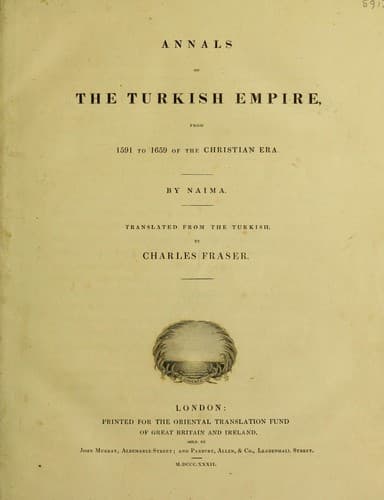
Annals of the Turkish Empire, from 1591 to 1659Naima, Mustafa
History
Annals of the Turkish Empire, from 1591 to 1659
Naima, Mustafa
Turkey -- History -- 1453-1683
The Waiwodas of Valachia were in the habit of providing horses and
oxen for the purpose of conveying cannon and other apparatus of war
when they were required to do so. But when messengers from Belgrade,
in the name of the grand vezír, required them to supply the army
before Besperim with three hundred of those animals, for the purpose
of conveying provisions and money, they manifested no small degree of
tardiness in complying, for which they were severely reprimanded.
And again, when they were required to send four hundred waggons with
food and money to the troops before Yanuk, they played the same trick,
for which neglect the drivers were ordered to be executed; but by
the intervention and intercession of the grand vezír’s son, Mohammed
Páshá, their lives were spared, but the presents which they carried
along with them were rejected with disdain. It was inconsistent, it was
said, that a country like Valachia should be controlled by one or two
indolent infidels, and therefore they might expect that next spring
the war would be carried thither. The men who had their lives spared
to them were kept prisoners, but were afterwards set at liberty. But
the prevaricator Michael, and this is the chief point to be observed,
became so enraged at the disgrace and dishonour thus manifested, that
the incorrigible wretch raised the standard of defiance, and became the
ostensible instigator of the rebellion which afterwards broke out in
Valachia in the following year, and to which, when we relate the events
of that year, we shall advert.
The arrival of Ghází Gheráí Khán from a country in which never infidel
stepped, and whose splendid achievements in war it is impossible fully
to delineate, relates chiefly to the same period.
About the middle of Rabia II., Fatima, daughter of the august and noble
monarch of the world, was united by marriage to the vezír Khalíl Páshá
in the old palace. At the commencement of the same month ambassadors
from Abdullah Khán, sultán of Transoxania, arrived in Constantinople.
About the same time, also, the admiral, Jeghala Zádeh, sailed with a
fleet to Messina, put the inhabitants into great fear, carried off
several galleys, and returned. The Jews and Christians hitherto wore
blue and yellow turbans; but it having been determined to humble and
disgrace them, they were ordered, in future, to wear fillets made of
black and scarlet cloth.
EVENTS OF THE YEAR 1003 H.
_The conquest of Yanuk._
Public-domain text, read in full here on John Shaqi.
Reviews
Reviews
No reviews yet
Be the first to share your thoughts on this work.
Join the Discussion
Join the discussion
Sign in to leave a comment or review.
Sign InorCreate an account