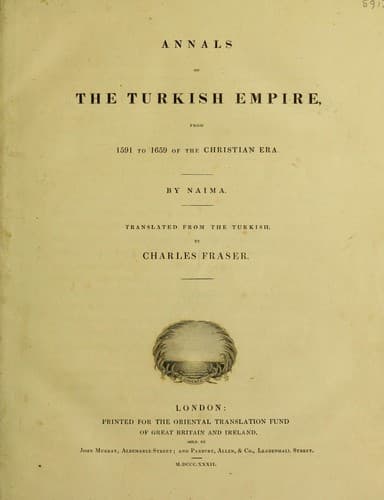
Annals of the Turkish Empire, from 1591 to 1659Naima, Mustafa
History
Annals of the Turkish Empire, from 1591 to 1659
Naima, Mustafa
Turkey -- History -- 1453-1683
Before leaving Buda, however, he sent off Rezván Aghá to carry tidings
to Constantinople of the fall of Yanuk, which he reached after fourteen
days’ travelling. The news of the fall of Yanuk was the cause of great
rejoicings in the metropolis, which were demonstrated by the roar of
cannon and the firing of musketry. To the Serdár and to the Khán a robe
of honour, a sword, and richly ornamented plumes, accompanied by royal
letters, were sent to each of these personages; also robes of honour
for each of the Beglerbegs and other dignitaries were sent off at the
same time.
_Concerning the bad management of the Commander-in-chief; his error and
failure in some other matters._
There is no evidence from the records of the intendant of the finances
what was the actual number of the troops employed in the war in
Hungary; he merely states that thirty thousand household troops were
sent thither. The army of Romeili was immense. After the death of
Soleimán Khán, and before the war commenced in Hungary, the people
thirsted for spoil. An army equal to that of Romeili, but destitute
of the means of subsistence, was collected in that quarter. A swift,
active body of troops, competent for every sort of depredation, and
equal to a whole province in number, assembled. The Tátárs alone
amounted to more than forty thousand. Such was the vast army the
commander-in-chief had under his command: such also was their fitness
for contending with the enemy, if properly and wisely directed.
When, however, the pensioned Janissaries entered their trenches, the
rest needlessly wasted their time in idleness: when the Khán and other
chiefs proposed to commit depredations in the enemy’s territories,
they were checked by being asked what advantage would accrue by
treading down one province? and yet it is a certain fact, that no
power whatever could have stopped the army, especially after the
victory gained at Yanuk, from reaching Vienna, had they been properly
commanded. When a deputation came from the country about Buda, begging
protection against rapine and plunder, they were told, that unless
one province fell another could not rise. To this very evident defect
and mismanagement in the government of the commander-in-chief is to
be attributed chiefly every misfortune which happened to the Moslems.
The peasants were made slaves, and villages were ruined. Some of the
most powerful of these peasants were roused to seek revenge: five or
six hundred of them seized on a palanka, and refused giving it up so
long as one of them remained alive. When their villages and hamlets
were robbed and plundered, they set fire to them and left them. The
mills near Belgrade were taxed. No apology was offered to the Waivodas
of Moldavia and Valachia for the heavy injuries done to them, but they
were still more oppressed; and when they sent their usual presents they
were rejected with disdain, and the bearers of them threatened with
Public-domain text, read in full here on John Shaqi.
Reviews
Reviews
No reviews yet
Be the first to share your thoughts on this work.
Join the Discussion
Join the discussion
Sign in to leave a comment or review.
Sign InorCreate an account