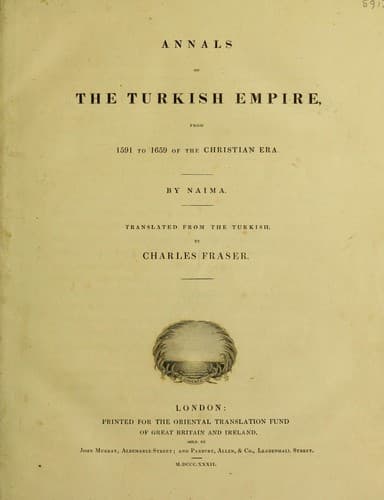
Annals of the Turkish Empire, from 1591 to 1659Naima, Mustafa
History
Annals of the Turkish Empire, from 1591 to 1659
Naima, Mustafa
Turkey -- History -- 1453-1683
In the month of Dhu’l hijja of last year the enemy, as we have seen,
laid siege to the fortress of Osterghún, and after having defeated
the army sent from Buda to oppose them, they redoubled their efforts
against the above place, which at last the Moslems were necessitated
to give up. This took place on the 1st, or about the beginning of the
month Sefer. About forty or fifty Mussulmans, who were allowed to leave
Osterghún, went by water to Buda.
_Vishégrade is taken by the enemy._
After the reduction of Osterghún the enemy surrounded the fortress of
Vishégrade, a place of considerable strength, not far from the above,
and which, through the treachery of one Osmán, who had been degraded
from the rank of an ághá of the Janissaries, was delivered over to the
enemy; but the inhabitants and the garrison were allowed to retire
to Buda. The above-mentioned apostate Osmán, in order to ingratiate
himself with the King of Hungary, went and pointed out the vaults in
which the Moslems had preserved their gunpowder, and which till then
had not been discovered. The enemy carried the whole away in boats.
_The Grand Vezír deposed.—Lála Mohammed Páshá made Grand Vezír._
When accounts of the ill fate of the expedition conducted by the grand
vezír into Valachia, of the pusillanimity of his son, who permitted
Osterghún to fall into the enemy’s hands; and who was the first who
fled from the field of battle, and shut himself up within the fortress
of Buda, were received at Constantinople, the whole of the Moslem
population and the grandees of the state were roused to madness and
indignation; and when the emperor was formally informed of these
disgraceful circumstances, he immediately ordered the grand vezír,
Sinán Páshá, to be deposed and to go to Mulghura. On the 16th of Rabia
II. the seals were transferred to Lála Mohammed Páshá, but who, on
account of his bad state of health, was never able, with the exception
of the day he had the honour of kissing the emperor’s hand, to attend
to his duties in the diván. He died shortly after his elevation to the
premiership.
_Sinán Páshá is made Grand Vezír a fifth Time._
The káímakám of Constantinople, Ibrahím Páshá, of whom frequent though
not honourable mention has been made, expected that on the death of
Lála Mohammed Páshá, as well as on some former occasions, when a prime
minister was degraded, that the emperor would confer the seals upon
him. He was mistaken, and of course disappointed. The fact was, that
the emperor had discovered before then that he was the principal cause
of Ferhád Páshá’s murder, and was seized with a kind of horror and
remorse, and therefore dismissed him from office and from his presence.
Public-domain text, read in full here on John Shaqi.
Reviews
Reviews
No reviews yet
Be the first to share your thoughts on this work.
Elsewhere in the archive
Join the Discussion
Join the discussion
Sign in to leave a comment or review.
Sign InorCreate an account