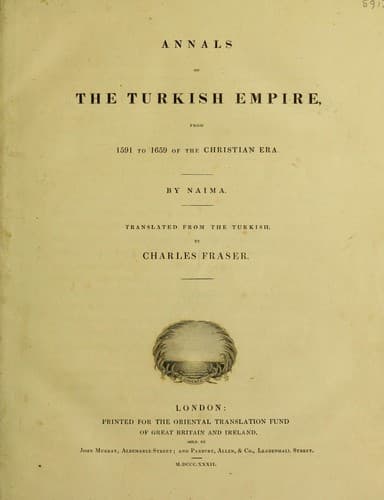
Annals of the Turkish Empire, from 1591 to 1659Naima, Mustafa
History
Annals of the Turkish Empire, from 1591 to 1659
Naima, Mustafa
Turkey -- History -- 1453-1683
The friends of Sinán, lately deposed and banished, were not idle. They
threw a cloak over his faults, and represented his virtues and high
qualifications for government in such a light as to induce his majesty
to recall him from his exile, and to reinstate him (a fifth time) in
his former office. He took his place in the diván about the end of
Rabia II.
A circumstance took place about this time which is worthy of being
recorded. A great dispute having taken place between Ibrahím Páshá and
his father-in-law, Sinán Páshá, the former accused the latter, in the
presence of the diván, of maladministration, and charged him with being
the cause of all the insurrections which had happened, by his having
given places of trust and responsibility to men who were unfit to hold
these offices. On another occasion Ibrahím spoke in the same strain in
presence of the emperor, which so enraged Sinán that he said: “I am
represented to your majesty as a person every way unfit to hold office,
and though it be Ibrahím who has thought fit to do so, I challenge him
to go down to the court, and there let us try the edge and strength of
our daggers.” Thus saying, he seized him by his robes and thrust him
out of the presence of the emperor. These were times in which rebellion
and disorder, hatred and envy, reigned without; rudeness and asperity
within; and had the effect of marring the tranquillity of all ranks
and conditions.
_Sinán Páshá’s counsel to the Emperor._
One day when the grand vezír was sitting with his imperial majesty he
offered him the following counsel. “Sire,” said he, “it is inconsistent
with sound policy to have a commander-in-chief in hostile countries,
and it is incompatible for two to hold that office. In having a
commander-in-chief, or a person of this description, it falls either
to the grand vezír, or some other one of the vezírs, to hold it. If
the grand vezír exercise this function, then the káímakám, in order
to get himself into the vezírship, will throw all the hindrances he
possibly can in his way, and no good will be effected. On the other
hand, if it be a vezír who shall exercise that high office, then the
grand vezír, for fear his services should, perchance, recommend him to
hold the premiership, will, from mere envy, seek to hide what glory
he may acquire in the service of his country. For how many years have
ambition and envy of this kind been the cause of the ruin of our
armies, and the wasting of our treasures, without producing the least
benefit to the state, but, on the contrary, misfortune and disgrace!
Do you, therefore, Sire, imitate the example set before you by Sultán
Suleimán, and declare that you will, in person, take the chief command
of the army in the present war with the infidels on the north of our
frontiers. Do this, that, after you have gained victories, and restored
the fading glory of the Ottomans, you may then have it in your power to
make peace on honourable terms. The presence of the royal warrior in
Public-domain text, read in full here on John Shaqi.
Reviews
Reviews
No reviews yet
Be the first to share your thoughts on this work.
Elsewhere in the archive
Join the Discussion
Join the discussion
Sign in to leave a comment or review.
Sign InorCreate an account