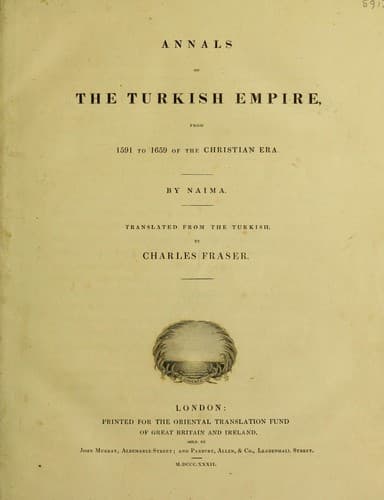
Annals of the Turkish Empire, from 1591 to 1659Naima, Mustafa
History
Annals of the Turkish Empire, from 1591 to 1659
Naima, Mustafa
Turkey -- History -- 1453-1683
On the third day after Ibrahím’s exaltation to the premiership, the
reverend Effendí, Sa’d-ud-dín, went to pay him a visit, and to do him
the honours due to his high office. Whilst the reverend father was
sitting and holding friendly conversation with the grand vezír, letters
were brought to his excellency, one of which was from Hasan Páshá,
son of Mohammed Páshá. This letter informed him of the submission of
the haughty Michael and of the Boyárs of Valachia. As the exalted
vezír was in the act of beginning to read these communications, the
Muftí arrived to congratulate the new minister, and formed one of the
company. These two magazines of learning and science sat, the one on
the right and the other on the left hand of the grand vezír, resembling
two lofty but firmly based mountains. These two august personages,
being noble, were permitted, of course, to sit and speak in the sublime
council. The papers above alluded to were put into the hands of the
reverend Effendí, who began to read their contents in a loud voice, and
gave his opinion freely on the points submitted to their consideration
and judgment. But the Muftí, from motives dictated by envy, opposed and
contradicted his reverend brother without ceremony. To his grave, wise,
and straight-forward advice he would give no place. This circumstance,
unfortunately, was the cause of producing a most serious altercation
between the two reverend prelates, which put a complete stop, for the
time being, to all further reading and cool deliberation. “Why,” said
the reverend Effendí, “if the Boyárs of Valachia, and Michael, have
petitioned for pardon, let no discouraging answer be returned to them.
Let them only be required to deliver up Michael’s son, as hostage,
in proof of the sincerity of their repentance. It is in this way, I
propose, their letters ought to be answered.” The superior priest, or
Muftí, under the influence of envy, opposed this judgment, and in his
turn maintained, that no offers whatever ought to be accepted at the
hands of the apostate Michael. The storm increased: mutual accusations
ensued. To such a length, indeed, did these reverend fathers carry
their animosity and personal reproach, that they completely exhausted
the patience of the other emírs present. At length the Muftí rose up
from his seat, turned himself to the grand vezír, and thus addressed
him: “If it please your excellency, we have come hither for the purpose
of congratulating you on your recent exaltation; not for contention
and strife: may the most high Allah, therefore, bless you in your high
office.” Thus saying, he returned to his own house. The other prelate
was very much offended at the Muftí for his outrageous conduct, who,
at the very commencement of their deliberations, began to oppose his
opinion and advice, and then marched off in a pet. This, he said, was
far from being honourable. However, he had this consolation afforded
him: his advice was adopted and followed. Orders accordingly were given
Public-domain text, read in full here on John Shaqi.
Reviews
Reviews
No reviews yet
Be the first to share your thoughts on this work.
Elsewhere in the archive
Join the Discussion
Join the discussion
Sign in to leave a comment or review.
Sign InorCreate an account