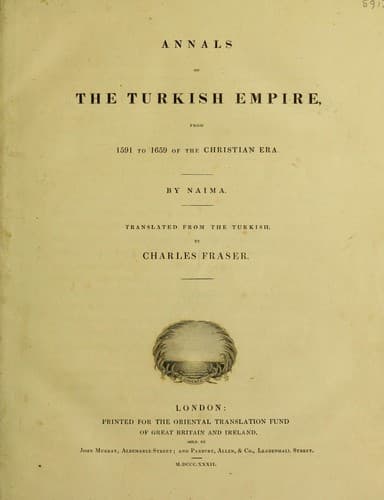
Annals of the Turkish Empire, from 1591 to 1659Naima, Mustafa
History
Annals of the Turkish Empire, from 1591 to 1659
Naima, Mustafa
Turkey -- History -- 1453-1683
to Músá Chelebí, the secretary, to prepare a suitable answer to Michael
and the other Boyárs, and Sa’d-ud-dín Effendí returned home.
_The Emperor of the Moslems prepares to set out for the scene of war._
By the time the spring arrived the preparations deemed necessary
for the war were fully attended to, and on the 15th of Ramazán the
different commanders were appointed. Immediately after the feast in the
month of Shevál the royal pavilion was erected on the plains of Dávud
Páshá. The ulemá and great men were ordered to join the royal suite,
and record the deeds of the war. On the journey, Sa’d-ud-dín Effendí
regaled the royal ear, in presence of his vezírs, by talking to him
of foreign affairs. On reaching Adrianople, the reverend prelate’s
second son, Izzet Effendí, a eunuch and cazí of Adrianople, applied to
his father to importune the emperor in his favour for the cazíship of
Constantinople. The father’s request was graciously granted. The grand
army had scarcely commenced its march towards Philippopolis, when Izzet
Effendí directed his course to the metropolis, but was disappointed.
Abdul Helím Effendí, through the intercession of the queen-mother,
was confirmed in the office of which Izzet thought himself sure, and
was obliged to retrace his steps to the place whence he came. When
his father had learned that his wishes respecting his son had been
thwarted, he approached the grand vezír, and complained against the
Káímakám Hasan Páshá, for his want of politeness, and of the disdain
and contempt which had been shown to his son. The grand vezír went
immediately and laid the affair before the royal presence, and added,
that it had been owing to the intercession of the queen-mother the
favour had not been granted: but something else he intimated ought
to be conferred on the reverend priest as an equivalent. The monarch
ordered his minister to create him a military judge, which was
accordingly done. His father soon after this fell sick of a fever, but
was fully restored to health by the time the city of Agria was taken.
On the 8th of the month Dhu’l Kadah, the emperor removed from
Adrianople, and after reaching Philippopolis, the fifth stage, the cazí
of that city, Chelebí Kází, inspector of the river Ebras, gave him a
splendid entertainment in a large pavilion erected for the occasion.
During four days which the emperor passed in this city, nothing was
seen or heard but demonstrations of joy. Chelebí Kází was confirmed in
his office for life.
When the emperor arrived at Batchina, Mohammed Páshá, son of Sinán
Páshá, came with a choice body of troops and saluted him. Two days
afterwards, Jeráh Mohammed Páshá, who was sent to Belgrade to collect
provisions, &c. for the army, came out to meet the emperor, and had the
honour of kissing his hand. Shortly afterwards the emperor entered the
city of Belgrade, where every thing had been prepared for the reception
of the royal guest.
Public-domain text, read in full here on John Shaqi.
Reviews
Reviews
No reviews yet
Be the first to share your thoughts on this work.
Elsewhere in the archive
Join the Discussion
Join the discussion
Sign in to leave a comment or review.
Sign InorCreate an account