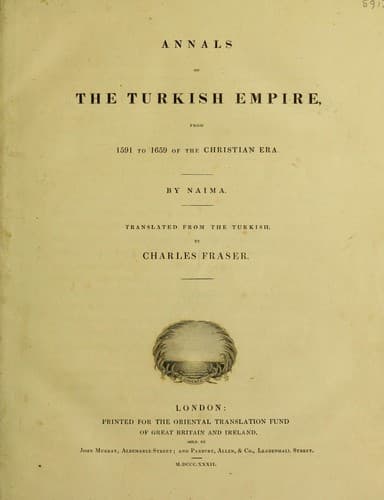
Annals of the Turkish Empire, from 1591 to 1659Naima, Mustafa
History
Annals of the Turkish Empire, from 1591 to 1659
Naima, Mustafa
Turkey -- History -- 1453-1683
His majesty, the asylum of the world, removed from Belgrade, crossed
the Save, and on arriving in the neighbourhood of Islancúmin, called
a general council of all his princes, great lords, and high vezírs.
In this council it was discussed whether it would be more advisable
to commence their operations by first laying siege to Komran, or
to proceed directly to Agria. To Jaghala Zádeh the first of these
two proposals seemed the most proper; but the other vezírs opposed
this. They said that Komran was a place of no note, and of no great
importance: neither would the reduction of it reflect any great credit
to their royal leader, nor very much intimidate the enemy. Agria, they
maintained, and justly too, was a place of great importance, it being
one of the largest and most populous cities of the Germans, the chief
or principal one within the limits of Hungary; famed also for the mines
which abound in its neighbourhood, and which are held in much esteem
by the infidels. The reduction of this city and fortress, continued
the speakers, will extend the glory and promote the honour of the
Moslem religion. This speech had the effect it was intended to have;
and, accordingly, the army, in order to reach Segdin, in the enemy’s
country, passed the fortresses of Tetul and Waradin, when the ághá of
the Janissaries was ordered to proceed with carpenters and erect a
bridge of boats across the Danube; which he accomplished in the space
of four days. The emperor, vezírs, and the army, after having crossed
this bridge, waited a whole day, until all the ordnance and heavy
baggage were also safely got across, when they proceeded to the plains
of Segdin, and pitched their camp opposite that fortress.
Here the royal camp was joined by the army of Romeilia with their
beglerbeg, Hasan Páshá, a heroic vezír, at their head, and the sight
of whom inspired the royal troops with animation and courage. His
battering cannon he caused to be transported in boats along the Danube
from Widin; and among other important services which he rendered on
this occasion, he caused all the other Romeilian princes to be sent
down the river Tisse to Segdin.
The army was not long at Segdin before a number of letters were
presented before the royal presence by a deputation from the borders,
which set forth the conduct of the detestable enemy in laying siege
to Khutván, and many other grievances which these infidels had given
occasion to complain of. The deputation added, that if immediate aid
were not afforded, the besieged Mussulmans would inevitably fall into
the hands of the enemy and perish.
Public-domain text, read in full here on John Shaqi.
Reviews
Reviews
No reviews yet
Be the first to share your thoughts on this work.
Elsewhere in the archive
Join the Discussion
Join the discussion
Sign in to leave a comment or review.
Sign InorCreate an account