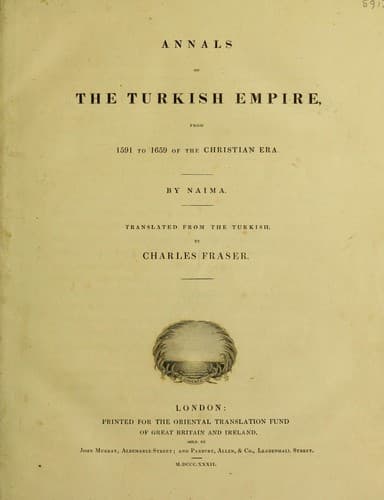
Annals of the Turkish Empire, from 1591 to 1659Naima, Mustafa
History
Annals of the Turkish Empire, from 1591 to 1659
Naima, Mustafa
Turkey -- History -- 1453-1683
To prevent, therefore, the disgrace of allowing these Mussulmans to
perish by the enemy’s sword, Jaghala Zádeh was ordered to proceed with
a party of troops to their aid, and beat off the besiegers. But Jaghala
Zádeh, another son of Sinán Páshá, was too tardy in his movements,
and before he had time to arrive to afford aid to Khutván, it was in
the hands of the abject enemy. All the men, women, and children were
put to death, and the fortress itself was made level with the ground.
The conduct of Jaghala Zádeh on this occasion was such as deserved
the severest punishment; but being highly esteemed and of noble
birth, he not only escaped with impunity, but even without reproof, a
circumstance which is truly marvellous and confounding.
About this same time, also, the troops created a tumult, and complained
against Hájí Ibrahím Páshá, the treasurer, under the pretext of not
receiving their dues; for which reason the treasurer was deposed and
Kej Dehán Alí, a chávush báshí, was appointed in his stead. On the
18th of the Moharrem the troops were all paid their wages, each man
receiving his usual allowance.
After the army had reached the vicinity of the fortress of Sonluk they
disembarked their serpent and dragon-mouthed cannon, which they had
conveyed thither by water, and transported them on sledges drawn by
oxen towards Agria, as also their heavy baggage. The royal camp, after
three other stages were accomplished, reached, without being observed,
an open field in the skirts of the city, where the necessary quantity
of arms and ammunition was immediately distributed among the troops.
_Agria besieged._
It was on the 28th of Moharrem that the Sháhin-Sháh of the universe
pitched his royal camp in the plains of Agria. The two first days were
employed in arranging the machinery for making the ditches and raising
mounds, and in examining the ground.
Agria appeared, in the distance, like a mountain. The top of the
fortress was hid in the clouds; its towers rose one above another; and
its lofty buildings and turrets filled the eye. The fortress itself was
situated on a high hill, and three parts of it presented a rock, on
which was built a wall so firmly constructed that cannon could hardly
affect it. A huge mineral rock adjoined it on the south side, and as
a guard to their outer works or fortifications, there was an immense
deep ditch cut in front of them. In short, it was a place of the
utmost strength—a first-rate fortress. There were in it at this time
two princes; the one a relation of the Emperor of Austria, who was the
commander of the Germans in it; the other the Prince of Hungary.
Public-domain text, read in full here on John Shaqi.
Reviews
Reviews
No reviews yet
Be the first to share your thoughts on this work.
Elsewhere in the archive
Join the Discussion
Join the discussion
Sign in to leave a comment or review.
Sign InorCreate an account