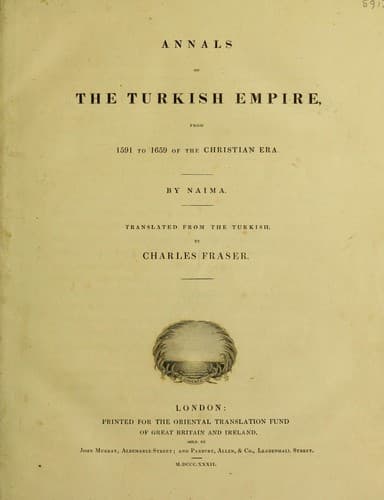
Annals of the Turkish Empire, from 1591 to 1659Naima, Mustafa
History
Annals of the Turkish Empire, from 1591 to 1659
Naima, Mustafa
Turkey -- History -- 1453-1683
After it had been fully ascertained what the enemy meditated to do,
Ja’fer Páshá, one of the most illustrious vezírs, and an eunuch, was
dispatched with a chosen body of various troops to surprise the enemy
in their strong-hold. Ja’fer Páshá, on leaving the camp, began to
reflect what the issue of the expedition on which he was sent might be,
and therefore sent out spies, who brought him intelligence with regard
to the numerical force of the enemy, which was immense. Ja’fer Páshá,
on receiving the above intelligence, sent word to his Majesty that his
offering to contend with such a vast multitude with so small a force as
he possessed, could only terminate in disgrace and ruin. For his own
part, he said, the thought of his own life gave him no concern, and
that at all times he was ready to sacrifice it, when necessary, for the
honour and glory of the Mohammedan Faith: to proceed to the assault,
therefore, under such circumstances, could not fail, as he had before
observed, to throw disparagement on the Supreme authority: the great
men in the camp however said, that this story was a mere pretence; and,
in order to remove it, proposed sending the governor of Romeili with
his Romeilian troops to his assistance. This proposal was accompanied
by bitter reproach, and of course was very discouraging; yet Ja’fer
Páshá, notwithstanding all this untoward aspect of things, attempted
to face the enemy with the forces he had. After having girded on his
arms he divided his artillery into two divisions, and having rescued
his men out of the mud into which they had sunk, conducted the whole
to a secure spot, but from which the enemy could not yet be observed.
It was not long however before they began, like black mountains, to
make their appearance, and seemed as if they covered the whole surface
of the plains of Mehaj. Ja’fer Páshá, with a select body of borderers,
ascended an eminence in order to get a view of the enemy’s camp, which
had the appearance of an extended sea, whose raging billows beat
against the shore. Though the troops of Ja’fer Páshá amounted only to
three thousand, he resolved, few in comparison though they were, to
attempt something, and prepared to engage some of these iron-cased
infidels. They on perceiving his boldness dashed towards his standard
and knocked it down. The contest became general. Ja’fer himself fought
most desperately, though almost up to the breast in mud and water; and
continued thus to show his bravery, till all who were about him either
perished or fled from the contest, and he himself was nearly taken
prisoner: such was the heroic boldness which this brave man evinced
on this occasion of unequal battle. Several of the ághás came up to
him and begged him on bended knees to retreat. “It was no bravery,”
they observed, “for a handful of men to contend with a host; it was
not necessary, in order to escape the reproach of the enemy, to throw
one’s self into utter ruin and destruction: it was impossible for a
Public-domain text, read in full here on John Shaqi.
Reviews
Reviews
No reviews yet
Be the first to share your thoughts on this work.
Elsewhere in the archive
Join the Discussion
Join the discussion
Sign in to leave a comment or review.
Sign InorCreate an account