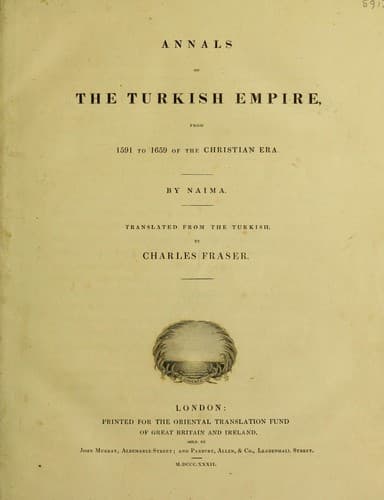
Annals of the Turkish Empire, from 1591 to 1659Naima, Mustafa
History
Annals of the Turkish Empire, from 1591 to 1659
Naima, Mustafa
Turkey -- History -- 1453-1683
small number of men, however valiant they might be, and where there
was not _one_ to a thousand, either to resist such a vast multitude as
that with which they then contended, or even to make an impression upon
it. Return,” they still continued, “return to the Moslem camp, and do
not be the cause of the destruction of troops whom no one will blame.
Such conduct can never advance the general interest.” This exhortation
had not the desired effect on the mind of the valorous chief. It was
night before he consented to yield to their entreaties. One Ahmed, in
consequence of the darkness of the night, led his horse to the gates
of Agria. The whole of his ordnance and heavy baggage fell into the
hands of the enemy. About thirty or forty of the men perished; and had
not night come on, not one of those who had entered the lists with the
iron-cased soldiery would have escaped alive. Their retreat was however
marvellously quick, for they performed in one night a journey of three
days.
The emperor, on receiving intelligence of the above disaster, which was
now become public, was displeased with Ja’fer, reprimanded him for his
adventurous mode of attack, which ought to have been made during the
night, deposed him from all his offices, and granted his principality
to Mohammed Páshá, Sinán Páshá’s son.
On the morning after the disaster above described took place, the
grand vezír, the reverend prelate, Sa’d-ud-dín, the vezírs and other
magnates assembled in the royal pavilion, in order to take into grave
consideration the propriety of giving the enemy battle or not. In
this august assembly most of the grandees opposed the experiment of
offering the enemy battle. The excellent and reverend Sa’d-ud-dín,
however, formed an exception. He rose and addressed the assembly in the
following heroic speech: “Doubtless, it is right,” said he, “to give
battle to the enemy of our religion and perish to a man, rather than
suffer their insult to pass unnoticed and with impunity: for should
they perceive any unwillingness on our part to meet, or if they see
us begin to retrace our steps, then most assuredly they will attack
us. To act in this way, would be like alluring a bird into a gin. More
especially,” continued he, raising his voice, “was it ever heard that
an emperor of the Ottomans turned away his face from danger!” And
even after the members who composed this council entered the royal
apartment, he continued to express the same sentiments and with the
same freedom—and again added: “the situation in which this fortress
(Agria) is situated, is far from being favourable to our engaging
with them in so narrow a space. Should they, for instance, succeed in
placing their artillery on the surrounding hills, we shall find it
hard work to resist them. The plains where the enemy now lies encamped
afford ample space for performing heroic exploits: thither let us
march. This is the first and only thing which ought to be attended
to.
Public-domain text, read in full here on John Shaqi.
Reviews
Reviews
No reviews yet
Be the first to share your thoughts on this work.
Elsewhere in the archive
Join the Discussion
Join the discussion
Sign in to leave a comment or review.
Sign InorCreate an account