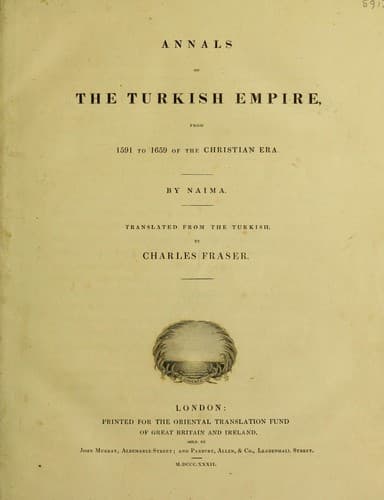
Annals of the Turkish Empire, from 1591 to 1659Naima, Mustafa
History
Annals of the Turkish Empire, from 1591 to 1659
Naima, Mustafa
Turkey -- History -- 1453-1683
We must attack them and not they us.” So much for the reverend
prelate. The bold and heroic speech of the veteran priest made a deep
impression on the heart of his royal master, and awakened within him
that innate bravery which he had inherited from his ancestors.
It was proposed by some in the assembly, that Hasan Páshá, the válí
of Romeili, should be appointed to conduct the next attack. This
was opposed. To conduct so important an expedition as the one now
contemplated, it was absolutely requisite, not only that the whole
of the army should be called into requisition, but that the emperor
himself should be its conductor. This last proposition met with the
royal approval, when the discussion, of course, came to an end. The
Reïs Effendí immediately sent off dispatches to Sultán Fateh Gheráí,
brother to the Tátár khán, in which he instructed him to be on the
look-out for such stragglers as might chance to fall in his way.
After the above-mentioned assembly or council broke up, the grand
vezír Ibrahím Páshá entered into the fortress, and made a selection
of such pieces of ordnance as could most easily be made use of in the
approaching conflict. Among other arrangements which the grand vezír
attended to, he appointed Súfí Sinán Páshá and Lála Mohammed Páshá,
governor of Anatolia, with his provincial troops, to take charge of the
garrison or rather fortress of Agria. Towards evening he returned to
the emperor’s pavilion, when a note from the reverend prelate was put
into his hand; it imported, that if the Anatolian troops were to occupy
the fortress of Agria, his majesty, when he entered the field of battle
in consequence of this arrangement, would necessarily be defenceless on
one side. “This,” said the sagacious prelate, “is a dangerous thing.
If the enemy should even attempt to get possession of Agria, its
present garrison is sufficiently able to hold out till succours can be
sent to them. From the garrison, in the day of battle, no aid can be
expected. It is therefore proper that the troops of Anatolia, according
to ancient custom, be appointed to form the right wing.” Lála Mohammed
Páshá was, accordingly, ordered to be in readiness with the troops
under his command.
After having made a distribution of provisions to those employed in
repairing the breaches and appointed to garrison the fortress, many
of whom were very ill off, the zealous, the orthodox army stood fully
prepared to take the field.
_The Orthodox Army advances to attack the Enemy._
Public-domain text, read in full here on John Shaqi.
Reviews
Reviews
No reviews yet
Be the first to share your thoughts on this work.
Elsewhere in the archive
Join the Discussion
Join the discussion
Sign in to leave a comment or review.
Sign InorCreate an account