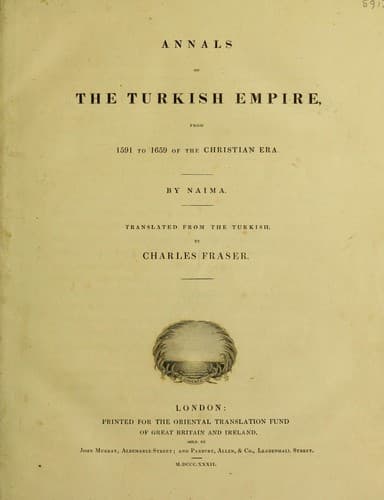
Annals of the Turkish Empire, from 1591 to 1659Naima, Mustafa
History
Annals of the Turkish Empire, from 1591 to 1659
Naima, Mustafa
Turkey -- History -- 1453-1683
Notwithstanding all this hostile attitude in which the Moslem, the
orthodox troops, arrayed themselves before their enemies, they,
singularly enough, never once showed their faces till about mid-day,
though in fact they had made every preparation. Suddenly, however,
about that time of the day, their foot soldiery came pouring forth in
chariots, and after them the iron-cased dragoons, troop after troop,
to the amount in all of fifteen or sixteen thousand, and formed, as it
were, an irresistible barrier. Their field-pieces were placed in the
most excellent order. At every step almost they fired their muskets and
discharged their cannon, and continued advancing on the Moslem army
like a horde of swine, whom even _Rustam_ and _Zál_[5] would hardly
think of resisting. Their columns resembled mountains of iron, and
their lines seemed incapable of being broken. The right wing of the
Moslems gave way, and were thrown into confusion: the left, composed
of the household troops, after making a mighty and heroic resistance,
was overpowered, when the enemy forced their way to the Moslem side of
the marsh. At this moment of vehement struggle and impetuous movement,
the Tátár troops advanced and supported their chief Fateh Gheráí, and
thus checked, in some degree, the progress of the enemy. That part of
the enemy which had succeeded in throwing the right wing into confusion
made a strong effort to reach the royal tent, and was only restrained
for a short time by the Romeilian troops, brought up by Hasan Páshá,
who with the utmost celerity attacked them in the rear, but was again
repulsed by the briskness of the enemy’s fire. The Spáhís, weakened by
the fatigue they had undergone, and hopeless of victory, were obliged
to withdraw. The rest of the troops, perceiving the field thus clear
of their companions in arms, conjectured at once that the emperor had
fled, and therefore immediately turned about, some taking the road to
Belgrade, some to Buda, and thus leaving the enemy complete masters of
the field. The victorious enemy now commenced the work of spoliation:
they entered the Moslem tents and laid their hands on every thing which
came in their way. Five thousand of these wretches came within bow-shot
of the emperor’s sejada, or prayer-carpet, when the most desperate
struggle ensued. Musselman and Káfir, laying aside their muskets,
betook themselves to their swords, and fell to cutting and slashing
each other with the most deadly animosity. The vezírs and nobles
rallied round his majesty’s person, and defended him with the most
heroic bravery; and when some of the execrated wretches endeavoured
to cut the cords of the royal tent, the ághás who were within it
rushed out and slew them. It was a period which might be called an
antetype of the day of the resurrection, wherein these Moslems, a mere
handful, evinced the warm and genuine feelings of their loyal hearts.
The reverend prelate, Sa’d-ud-dín, was not wanting in his duty: he
Public-domain text, read in full here on John Shaqi.
Reviews
Reviews
No reviews yet
Be the first to share your thoughts on this work.
Elsewhere in the archive
Join the Discussion
Join the discussion
Sign in to leave a comment or review.
Sign InorCreate an account