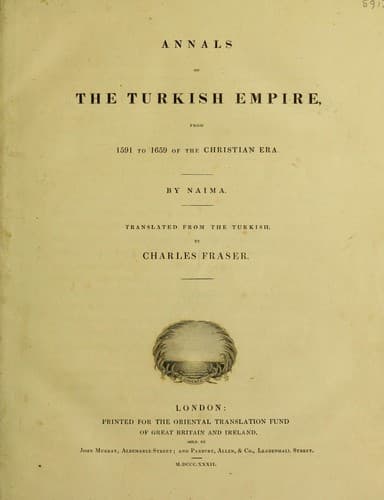
Annals of the Turkish Empire, from 1591 to 1659Naima, Mustafa
History
Annals of the Turkish Empire, from 1591 to 1659
Naima, Mustafa
Turkey -- History -- 1453-1683
translated, explained, and enforced the following sentiment: “Victory
is gained by patience, and after difficulty comes prosperity,” which
was calculated both to console and tranquillize the afflicted monarch’s
mind: he augured, also, a happy reverse.
The despicable but now triumphant infidels, thinking themselves
perfectly secure from any further annoyance from the defeated Moslems,
were intent only on acquiring spoil. God did not let them, however,
escape without a mark of his signal vengeance. They dispersed
themselves among the tents of the royal camp in search of booty, and
thus became divided. Their minds were engrossed wholly in this way,
and it so happened, by the providence of God, whilst fearlessly thus
employed, that the grooms, cooks, muleteers, camel-drivers, grooms, and
other servants which remained in the camp, perceiving the scattered
condition of their vile visitors, seized, some on axes, some on knives,
or whatever other weapon fell into their hands, and fell upon these
regardless spoliators, and slew as many of them as they were able. This
unlooked-for retaliation so terrified these robbers that they all fled,
and never halted till they got beyond their own fortifications. The cry
that the infidels were routed was now sounded, and spread like wildfire
every where. The affrighted Moslems returned from their hiding-places
and commenced pursuing the fugitives, and slew immense numbers of
them. According to the most authentic accounts it appears, that in
this pursuit the pursuing army, lately vanquished but now triumphant,
killed no less than 100,000 of these infidels. The victory was most
decisive: the fear of the Moslems so seized upon them that they fled in
all directions. The Moslem pádisháh (emperor) was declared conqueror
in the battle of Mehaj: his righteous cause triumphed, and the fame
of Islamism and that of the Ottoman empire was raised to the highest
renown. Never at any former period did any emperor, by so simple and so
extraordinary a means, acquire so much glory. Some, however, have given
a very different account of this battle.
Public-domain text, read in full here on John Shaqi.
Reviews
Reviews
No reviews yet
Be the first to share your thoughts on this work.
Elsewhere in the archive
Join the Discussion
Join the discussion
Sign in to leave a comment or review.
Sign InorCreate an account