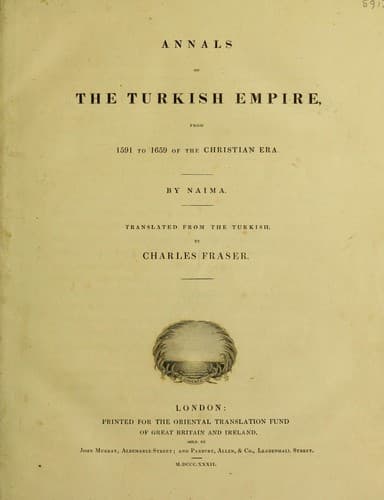
Annals of the Turkish Empire, from 1591 to 1659Naima, Mustafa
History
Annals of the Turkish Empire, from 1591 to 1659
Naima, Mustafa
Turkey -- History -- 1453-1683
Two regiments of them made towards the imperial treasures, dispersed
the Janissaries and Spáhís who had been appointed to guard them, drew
out the coffers from the tent in which they were placed, threw down
their cross-bearing banners, and began to dance for joy; but their joy
was not of long duration.
These disastrous appearances altogether were truly afflicting, and to
none did they appear more so than to Sa’d-ud-dín Effendí. He counselled
his majesty to continue firm and to maintain his position. “Such is the
state of matters at present,” said he to his majesty, “and such they
frequently were in the days of your illustrious progenitors; but depend
upon it,” continued the reverend prelate, “depend upon it, that by a
Mohammedan miracle the Mohammedan people, God willing, will yet obtain
the victory: keep up, therefore, sire, your spirits, and be of good
courage.” It is related that the emperor was informed of the disasters
which befell his army whilst he was sitting on horseback, and the
reverend prelate standing at his stirrup, to whom he dictated a humble
and earnest supplication, which the prelate offered up to God. The
Germans have recorded that this prayer or supplication was heard.
Of the enemy’s entering the royal camp, and of their having given
themselves over to the work of spoliation, we have already spoken. The
enemy were astonished beyond bounds at the sight of the vast riches and
wealth which the Osmánlí camp presented to their view. In fact, their
eyes had never before seen such a quantity of wealth. In their thirst
and greediness to acquire the valuables they every where saw around
them, they forgot, or laid aside the art of war. The repulsed Moslems,
seeing how their enemies were engaged, and watching their every motion,
began to reflect how they might recover their property which their
enemies were busily employed in appropriating to themselves. Just at
this moment, and towards evening, an army raised up by God himself
accomplished the destruction of these wretches. The grooms, cooks, and
other menials who belonged to the camp, and who still remained in it,
were roused to indignation. Some seized on axes, some on spades, or
similar instruments, and fell, with undaunted fury, on the robbers,
and slew many of them. The barbarians, by this circumstance, were
panic-struck, and began to run away. The cry now resounded that the
enemy had fled: the Moslems, who through fear had fled from the field
of battle, returned at this exhilarating sound, fell with exasperated
rage on the fugitives, and killed every one they were able to overtake.
Not a few even of those of them who wore chains perished from fear
and palpitation of heart. It may be affirmed, without incurring the
charge of overstepping the bounds of truth, that fifty thousand of
these hateful wretches fell by the edge of the sword. Very many of
them stuck in the mud, and were there beheaded. Twenty thousand of
their cavalry perished in one short hour on the right of the camp,
Public-domain text, read in full here on John Shaqi.
Reviews
Reviews
No reviews yet
Be the first to share your thoughts on this work.
Elsewhere in the archive
Join the Discussion
Join the discussion
Sign in to leave a comment or review.
Sign InorCreate an account