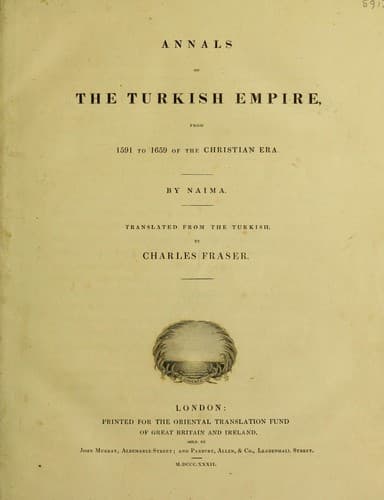
Annals of the Turkish Empire, from 1591 to 1659Naima, Mustafa
History
Annals of the Turkish Empire, from 1591 to 1659
Naima, Mustafa
Turkey -- History -- 1453-1683
The Defterdar (treasurer or recorder) Ibrahím Effendí, who himself
was present in this war, relates it thus: On the morning of that day
(_i.e._ on which the Moslems were defeated, but afterwards became
conquerors, as above related), the Moslem army directed their movements
towards the church situated near the lake; but finding the enemy had
retreated within their fortifications they advanced, after having
crossed the ford in that quarter, towards the enemy’s strong-hold,
keeping their cannon in the rear. The enemy, keeping close within their
fortifications, did not venture to show themselves till near mid-day,
when they began to issue forth in multitudes. 1st. The German foot
soldiers, all of them covered with mail and carrying arms. 2d. Another
body of the same race covered with breast-plates of iron, carrying
arms called muskets, which were capable of discharging ten, fifteen,
or twenty drachms weight. 3d. A body of Hungarians, consisting of one
hundred companies, each company amounting to five hundred men, on foot
and carrying fire-arms. 4th. The Hungarian cavalry, whose display of
standards and flags made them resemble a mountain covered with trees.
Besides all these there were also Germans, Bohemians, Poles, and men
of other nations, who were mounted on horses, and carrying some three,
some four, some five Hungarian fire-arms. The whole of this immense
army exceeded fifty divisions.
This immense number of troops is stated in the infidels’ own history
of events belonging to the period referred to. The karals (kings)
and dukes of different nations and states who aided the Emperor of
Austria in this war, caused the number of their respective troops to
be taken down, and the whole put together amounted to more than two
hundred legions, besides another army which they say had not reached
the field of battle. But to continue. The hostile divisions advanced,
maintaining as they did so a constant fire of musketry and other
fire-arms. Murád Páshá and the Bostánjí báshí, Alí Páshá, were sent to
support Sinán Páshá; but the dreadful effect of the musketry was such
that they found it impossible to withstand it, and therefore retraced
their steps across the marsh, when they dispersed themselves through
the fields. The enemy continued to press forward, with drums beating
and the constant roar of cannon and of musketry, directly towards the
royal camp. Hasan Páshá and his Romeilian troops were ordered to take
up their position at the head of the ford on the right, and oppose
them; but this effort proved ineffectual. The showers of musketry which
were poured in amongst them prevented their maintaining their ground
for a moment, and therefore they retired and joined the main body. The
fearless and inconsiderate infidels no sooner reached the royal camp,
though the Moslems were by no means broken and dispersed, than they
recklessly gave themselves over to the work of spoliation and plunder.
Public-domain text, read in full here on John Shaqi.
Reviews
Reviews
No reviews yet
Be the first to share your thoughts on this work.
Elsewhere in the archive
Join the Discussion
Join the discussion
Sign in to leave a comment or review.
Sign InorCreate an account