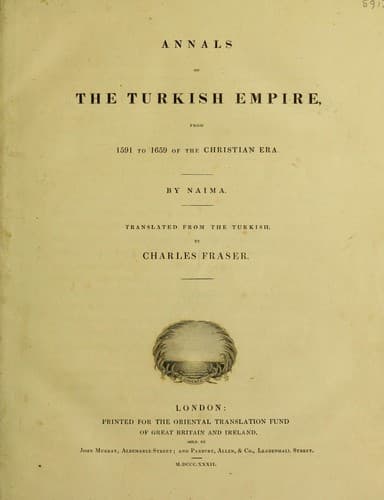
Annals of the Turkish Empire, from 1591 to 1659Naima, Mustafa
History
Annals of the Turkish Empire, from 1591 to 1659
Naima, Mustafa
Turkey -- History -- 1453-1683
Ibrahím Páshá was no sooner reinstated in the premiership than he
waited on his majesty, and paid him all due acknowledgment for the
honour conferred on him. On returning to the camp, he banished Mohammed
Aghá, master of the horse, the writer of this account; besides several
other favourites of the late grand vezír, whom he turned out of office.
Ghází Gheráí, the ex-khán, was reinstated in the regal dignity over
the Tátárs of the Crimea. Hasan Páshá, the son of Mohammed Páshá, who
was lately made commander-in-chief, was deposed, and Satúrjí Mohammed
Páshá appointed in his stead. Thus did Ibrahím Páshá compensate his
own friends for the injuries they had sustained in consequence of
his deposition. Even the reverend prelate Sa’d-ud-dín Effendí was
not allowed to escape without feeling the effects of the new vezír’s
displeasure. He was deposed from his high office, and to prevent him
from carrying on intrigue and fraud with the learned body of which he
was a member, he was obliged to live a recluse life, even that of a
hermit.
The services and heroism of Jaghaleh Zádeh we have already
contemplated. We have seen how he attributed the victory gained over
the infidels at Mehaj to his own bravery and proper management;
how he endeavoured to throw the services of Ibrahím Páshá into the
shade, and, in short, how he succeeded by fraud and artifice to get
himself created grand vezír. It is said that the emperor, when he
first petitioned to be made prime minister, demurred; and that it was
only after he represented the great interest he possessed among the
troops, who doubtless would create a tumult in his favour, if he was
not raised to the dignity of the premiership, that his majesty at last
agreed to confer the seals on him. In fact, he did not scruple even to
assert that there were not wanting signs of this disposition in the
soldiery at the very time he was speaking to the emperor, and thus
urged him to a compliance with his wishes. Jaghaleh was a man of great
intrepidity, but wrathful. His heart was unacquainted with gentleness
and compassion. In consequence of his reckless and horrible cruelties
towards the unfortunate fugitives, and other crimes, the hearts of all
were turned against him, and his downfall was sought. When Ibrahím was
again raised to the grand vezírship, new life seemed to be transfused
throughout all ranks; and all rejoiced at Jaghaleh’s misfortunes. The
chancellor, Alí Chelebí, who wrote a detail of the victories obtained
in the conquest of Agria, and in the battle of Mehaj, wrote it in the
name of Jaghaleh, as if he really were the conqueror, and praised
him in the most extravagant manner. For this he was not only sharply
rebuked, but also deposed. Okjí Zádeh was appointed in his stead.
Public-domain text, read in full here on John Shaqi.
Reviews
Reviews
No reviews yet
Be the first to share your thoughts on this work.
Elsewhere in the archive
Join the Discussion
Join the discussion
Sign in to leave a comment or review.
Sign InorCreate an account