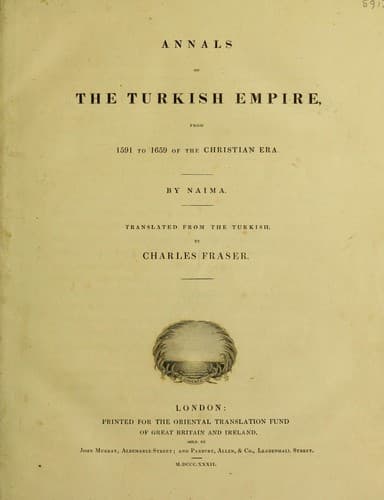
Annals of the Turkish Empire, from 1591 to 1659Naima, Mustafa
History
Annals of the Turkish Empire, from 1591 to 1659
Naima, Mustafa
Turkey -- History -- 1453-1683
When his majesty reached Dávud Páshá, on his return, he was there
met by the Káímakám Hasan Páshá, the eunuch, and the mufti, who came
thither with a splendid escort to congratulate his majesty on his
return, and on the successes which had attended the Moslem arms. On
the 6th of Jemadi II. the grandees and nobles preceded the army in
solemn procession to the imperial city, and conducted his majesty to
his royal palace, and for three successive days and nights the whole
exhibited nothing but demonstrations of joy. Núh Páshá was appointed
to the government of Caramania; and as a mortification to the reverend
prelate, so frequently mentioned in the course of this history, and
latterly so very unfortunate, his eldest son, Mohammed Effendí, was
deprived of his office of cazí, in Anatolia, which was given to Kúsh
Yahiah Effendí, who had been deposed from the jurisdiction of Mecca.
Two days after these changes and new appointments had taken place,
the prelate’s son-in-law, the governor of Romeili, Yahiah Effendí,
just mentioned, and the poet, Bákí Effendí, met and consulted together
how they might succeed in again bringing Sa’d-ud-dín into notice and
favour. They got the chancellor, Okjí Zádeh, to draw out a document in
his favour, recommending him to the cazíship of Mecca. But the grand
vezír, the prelate’s enemy, succeeded in getting some of the Aghás
about the queen-mother to hinder this document finding its way to the
royal presence, and kept it back two days.
In the meantime the reverend prelate was made acquainted with what was
going on in his favour, and sent his slaves and other property to the
empress, supposing she would, by her interference, prevent his being
sent to any place distant from the metropolis. He was mistaken: for an
answer to the above document or petition was sent to the petitioner,
which intimated that the reverend prelate, to prevent his exercising
fraud and deceit in future, should retire to a cell, and there pass
the remainder of his life in religious meditation. The learned body of
the Ulemá, however, ventured to oppose the grand vezír, and therefore
entered into consultation with the mufti, Bostán Zádeh, as to the way
they should act.
_Concerning Fateh Gheráí._
Public-domain text, read in full here on John Shaqi.
Reviews
Reviews
No reviews yet
Be the first to share your thoughts on this work.
Elsewhere in the archive
Join the Discussion
Join the discussion
Sign in to leave a comment or review.
Sign InorCreate an account