Great Britain -- History -- Elizabeth, 1558-1603 -- Fiction; Shakespeare, William, 1564-1616 -- Fiction
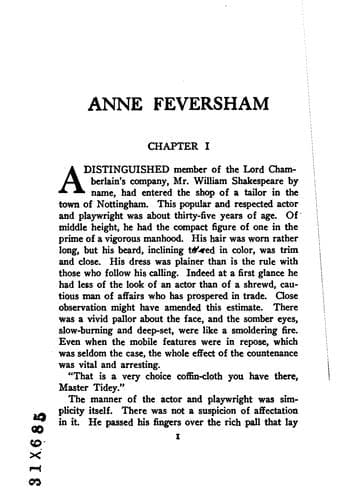
The tailor lowered his voice to a whisper. It was as if he feared to
be overheard. “They do say ’a has plotted with the Papishers, who are
always contriving against the Queen.”
“What’s the name of the unlucky youth?”
“His name is Mr. Gervase Heriot.”
“Mr. Gervase Heriot! He is a kinsman of my Lord Southampton.” A look
of keen pity came upon the player’s face. “I know the lad well enough.
He sat on our stage at The Globe less than two months ago. An open,
cheerful youth incapable of plotting against aught save a flask of
canaries, if I’m any judge of nature. Poor young man. Master Tidey,
this is a very tragic matter.”
“Sad enough, Master Shakespeare, sad enough,” said the tailor,
stitching busily at the coffin-cloth.
The actor passed a delicately shaped hand, the hand of a poet, across
his face. “More than once I have marked the lad as he sat in the
playhouse,” he said. “’A was a proper neat youth. ’A had a subtle
tongue and a very flaming eye. ’A was german-cousin to Perseus, him
that bestrid the winged horse. And now--with the taste of milk yet on
his lips!” The player ceased abruptly, as if overcome by a surge of
feeling. For a time he was silent. The tragic end of a youth of bright
promise appeared to weigh upon him sorely.
Master Nicholas Tidey, whose skill with the needle and shears had
spread far and wide over the midland counties, was, like the player,
a Stratford man. In a rather shamefaced way, the tailor was a little
inclined to be proud of his fellow-townsman. To be sure his calling
was hardly that of a Christian. On occasion his speech was apt to be
a little disorderly, it even verged upon the fantastical, but Master
Tidey was bound to admit that there must be something in the fellow.
For one thing, rumor had it that he had recently bought New Place,
the largest house in his native town. Such a fact spoke for itself,
even if a wise man was inclined to discount the glowing reports of the
play-actor’s ever-growing success which reached him continually from
London. But, even as far back in the world’s history as the age of
Elizabeth, “Nothing succeeds like success” was a maxim known to the
philosophers.
“They do tell me, Master Shakespeare,” said the tailor, “that some of
these harlotry pieces of yours have been approved by the Queen.”
The playwright could not help smiling a little at a certain uneasiness
which was apparent in the tone of his friend, in spite of the fact that
that honest man tried very hard to conceal it. “If I said they had not,
Master Tidey,” he answered, with dry modesty, “I might be speaking less
than I know. On the other hand, if I said that they had, a needy writer
for the stage might be claiming more than becomes the least of her
Majesty’s servants.”
Public-domain text, read in full here on John Shaqi.
Reviews
Reviews
No reviews yet
Be the first to share your thoughts on this work.
Join the Discussion
Join the discussion
Sign in to leave a comment or review.
Sign InorCreate an account