Great Britain -- History -- Elizabeth, 1558-1603 -- Fiction; Shakespeare, William, 1564-1616 -- Fiction
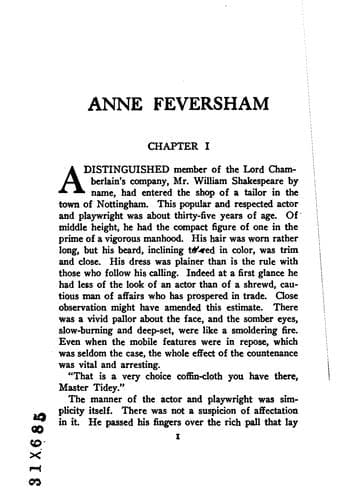
Still, even in that age there was a certain indulgence among the elect
for a man of acknowledged genius. And of such persons whom nature and
fortune had favored there was a number round the table in the center
of the room. At the foot of it, immediately opposite the vacant place
of his slightly eccentric co-manager, was Richard Burbage, who had
recently built the fine new playhouse on the Bankside in Southwark,
and who was held by all whose opinion was of weight to be the first
tragic actor of the time. Near to him was William Kemp, the famous
comedian, a burly, rubicund fellow, whose rolling, unctuous tones had
been nourished upon many an honest quart of sack. Farther along the
board were such excellent mimes as Taylor and Lowin and Heming and
Harrison, men highly accomplished in their calling, and of whom any
body of players had a right to be proud.
The Lord Chamberlain’s servants were on the floodside of success. At
this time they were going from strength to strength and outdistancing
all competitors. Even the Lord Admiral’s men had grown to envy
them. These were no unworthy rivals; men of wit and parts from the
universities were writing plays for them, but they had not the good
fortune to be inspired by a man of very brilliant and remarkable genius.
Richard Burbage’s co-director and part-proprietor of the new theater on
the Bankside was William Shakespeare, like all of these men an actor,
and perhaps a rather mediocre one. Yet wild horses would not have
dragged any such admission from his more accomplished brethren. For
these well knew that this man, whose air was so modest, so charming and
so friendly, was one whose own special gift was beyond all price. Times
and again, at the shortest notice, had he taken the lifeless corpse of
a forgotten play and with a few magic touches had made the dry bones
live.
More than once had Richard Burbage gone to him with a demand for
“something new for Twelfth Night.” And as sure as Burbage had done so
something new had been forthcoming; a piece such as to make the town
ring, and cause the Admiral’s men to bite their nails with envy. Plays
of all kinds, running through the whole gamut of the emotions, had
William Shakespeare devised. All sorts and conditions of men had been
enthralled by his remarkable talent.
“What new maggot has Will got in his brain?” inquired the famous Kemp
of the still more famous Burbage as he rolled a large and rather
bloodshot eye in the direction of the window.
“Nay,” said the tragedian, with an indulgent shake of the head, “I
know not, except that, as he would say, he is studying the great human
comedy.”
“Well, Dick,” said the comedian, “if you and I did not know that he had
rarer wit than any man alive we should think he was as mad as a March
hare.”
“It is a form of madness, friend William, that will never trouble you
and me,” said the tragedian, fetching a deep sigh in which there was
more than a suspicion of the idolater.
Public-domain text, read in full here on John Shaqi.
Reviews
Reviews
No reviews yet
Be the first to share your thoughts on this work.
Join the Discussion
Join the discussion
Sign in to leave a comment or review.
Sign InorCreate an account