Great Britain -- History -- Elizabeth, 1558-1603 -- Fiction; Shakespeare, William, 1564-1616 -- Fiction
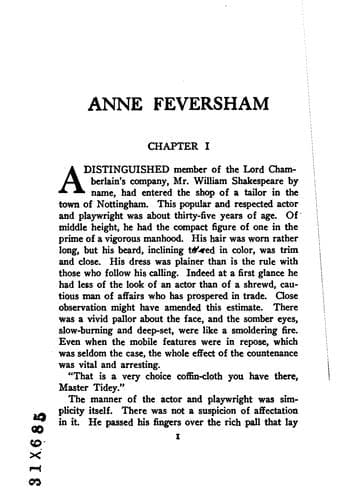
He dipped his quill into the horn of ink that was on the bench beside
him, and, with the never-failing instinct of the true craftsman, wrote
the title on the first page of his new comedy.
Scarce had he time to do this, however, when that swift, alert and
curious mind was engaged by an entirely new affair. There was the sound
of a horse’s hoofs on the cobbles leading to the tavern door. And the
playwright’s quick uplooking glance was met by the sight of a singular
traveler.
The newcomer was a man about twenty-five years old, riding a
useful-looking horse. But that which particularly drew the notice of
William Shakespeare was the hapless plight of man and beast. Both were
greatly distressed. The horse had evidently traveled far and swiftly:
it was caked with mud up to its withers; it was lame of a foreleg; it
was covered with sweat, and seemed hardly able to do another yard.
The case of the rider was in keeping with the horse’s unhappy state.
The man looked so limp and wretched that he could scarce sit in the
saddle. Moreover, he was wild-eyed and haggard; and his leather
riding-suit which seemed to denote a servant of a superior sort was in
sad disorder.
The man rode into the courtyard of the inn and handed over his weary
horse to an ostler. Then the rider, no less weary than his steed,
staggered painfully to the inn door. In a hoarse voice he called for
a tankard of ale and then flung himself heavily on the bench near to
where the player sat.
Shakespeare eyed the traveler with deep curiosity. The man was in such
a sorry plight that he could not refrain from pitying him. “You appear
to have traveled far, friend,” he said.
The man looked at the speaker in a manner to suggest that he might be
strongly averse from the delights of promiscuous conversation with a
total stranger. “Yes, I have traveled far,” he said, with a weary sigh.
He buried his head in his hands as if he were in despair. And even
after refreshment had been brought to him he did not heed it, but
continued in this attitude for some little time. Then suddenly he shook
off his lethargy and drank the ale. Feeling a little renewed, he called
for a second tankard.
“You don’t happen to have seen a couple o’ young gypsies traveling
through Oxford?” he asked suddenly.
Immediately the player grew very alert. “What kind of gypsies do you
mean?” he asked in a casual but wary tone.
“The taller of the two might be playing on the flute, I reckon, and the
younger one, who has the voice and look of a girl, might doubtless be
singing.”
William Shakespeare, as became a thoroughgoing man of the world, was
far too acute to blurt out on the spur of the moment the full measure
of his information. Rather he preferred to parry the question of this
singular traveler by putting a few of his own. “What might you be
wanting with them?” he asked cautiously.
Public-domain text, read in full here on John Shaqi.
Reviews
Reviews
No reviews yet
Be the first to share your thoughts on this work.
Join the Discussion
Join the discussion
Sign in to leave a comment or review.
Sign InorCreate an account