Great Britain -- History -- Elizabeth, 1558-1603 -- Fiction; Shakespeare, William, 1564-1616 -- Fiction
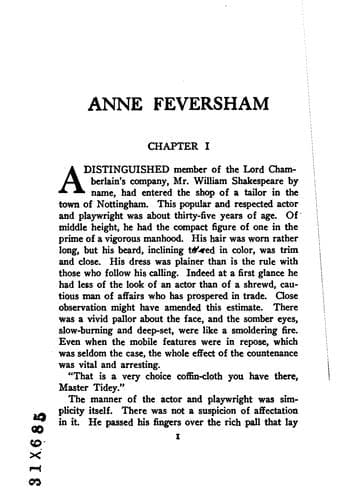
“We will thank God that Gloriana has at any rate a shrewd and seizing
mind,” said Richard Burbage, with enthusiasm. “At least, it will not be
above _her_.”
The playwright smiled the little sad smile that was so often his when
others chose to refer to his writings in his presence. None had ever
been able to interpret that gesture; none ever would, but it was a
smile of pain rather than of happiness.
With a sudden effort of the will the playwright cast these trivialities
out of his thoughts. “Dick,” he said, “I am come to talk of a matter
of more account than this. I would have you know that our poor young
Egyptians are returned.”
“Oh, a murrain on them!” The face of the tragedian grew startled and
discomposed. “Plague take them,” he said, “I had hoped we had seen the
last of them.”
“Poor souls!” said the playwright.
Never had Burbage seen his too-sensitive comrade--to whom he had come
to stand in the relation of a protective elder brother--in such a state
of distress. The tragic story had torn his heart. But the counsel of
the tragedian was sadly discouraging.
“If you will be ruled by me, my friend,” said that sage and practical
man of the world, “you will take precious care to keep out of this
matter. Let them go their ways. The times are perilous. And he who
touches affairs of state generally finds it easier to lose his head
than to keep it.”
“You are right there, Dick,” said the playwright, with an odd light
in his eyes. “But better a man should lose his head than forswear his
soul.”
Burbage knew that it was vain to argue with William Shakespeare in a
matter of this kind. There were certain things in which he was not as
other men. For all his childlike simplicity of character, he had yet
the power, as he had proved many times, to take a line of his own when
occasion called.
“Dick, we must help them,” he said.
“The surest way to do that is to give them money enough to quit the
country,” said the tragedian.
“But what of Sir John Feversham?”
Burbage threw up his hands impatiently. “He concerns us not,” he said.
“And I beseech you, my dear Will, to give not another thought to him.”
The playwright shook his head. “Nay, my friend,” he said, “let us not
leave a brave and honorable man to die.”
“To that I would say amen if in any sort we could avail him.”
“The Queen should learn the truth, I think.”
“How, pray, is she to learn it?”
“On Thursday se’nnight, if this unlucky man still lives, we must find a
way to tell her.”
But Burbage dissented strongly. “It would be madness, Will, sheer
madness for us to breathe a word on the subject. You know what the
times are. And when it comes to treason it takes but a very slight
thing to undo the best man alive.”
Public-domain text, read in full here on John Shaqi.
Reviews
Reviews
No reviews yet
Be the first to share your thoughts on this work.
Join the Discussion
Join the discussion
Sign in to leave a comment or review.
Sign InorCreate an account