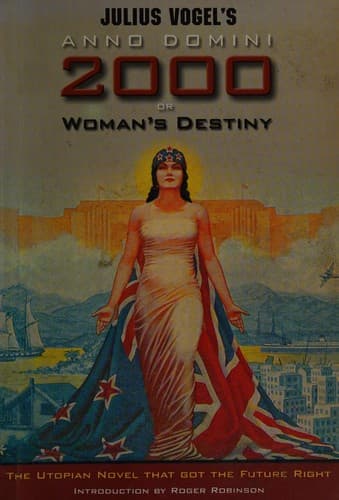
Anno Domini 2000; or, Woman's DestinyVogel, Julius, Sir
Science
Anno Domini 2000; or, Woman's Destiny
Vogel, Julius, Sir
Feminist fiction; New Zealand -- Fiction; Two thousand, A.D. -- Fiction; Utopian fiction; Utopias -- Fiction; Women -- Fiction
Twenty years have passed. The Emperor is nearly fifty, and the Empress
is no longer young. They have preserved their good looks; but on the
countenance of each is a settled melancholy expression, wanting in the
days which preceded their marriage. Their union seemed to promise a
happy life, no cloud showed itself on the horizon of their new
existence, and yet sadness proved to be its prominent feature. A year
after their marriage a son was born, amidst extravagant rejoicings
throughout the Empire. Another year witnessed the birth of a daughter,
and a third child was shortly expected, when a terrible event occurred.
A small dog, a great favourite of the child, slightly bit the young
prince. The animal proved to be mad, a fact unsuspected until too late
to apply adequate remedial measures to the boy, and the heir to the
Empire died amidst horrible suffering. The grief of the parents may be
better imagined than described. The third child, a boy, was prematurely
born, and grew up weak and sickly. Two more children were subsequently
born, but both died in early childhood. The princess, the elder-born of
the two survivors, grew into a beautiful woman. She was over eighteen
years old when this history reopens. Her brother was a year younger. The
contrast between the two was remarkable. Princess Victoria was a fine,
healthy girl, with a lovely complexion. She inherited her mother's
beauty and her father's dignity and grace of manner. She was the idol of
every one with whom she came in contact. The charm and fascination of
her demeanour were enhanced by the dignity of presence which never
forsook her. Her brother, poor boy, was thin and delicate-looking, and a
constant invalid, though not afflicted with any organic disease. They
both were clever, but their tastes were widely apart. The Princess was
an accomplished linguist; and few excelled her in knowledge of history,
past and contemporaneous. She took great interest in public affairs. No
statesman was better acquainted with the innumerable conditions which
cumbered the outward seeming of affairs of state. Prince Albert Edward,
on the contrary, took no heed of public affairs. He rarely read a
newspaper; but he was a profound mathematician, a constant student of
physical laws: and, above all, he had a love for the study of human
character. When only sixteen, he gained a gold medal for a paper sent in
anonymously to the Imperial Institute, dealing with the influence of
circumstances and events upon mental and moral development. The essay
was very deep, and embodied some new and rather startling theories,
closely reasoned, as to the effects of training and education.
Public-domain text, read in full here on John Shaqi.
Reviews
Reviews
No reviews yet
Be the first to share your thoughts on this work.
Elsewhere in the archive
Join the Discussion
Join the discussion
Sign in to leave a comment or review.
Sign InorCreate an account