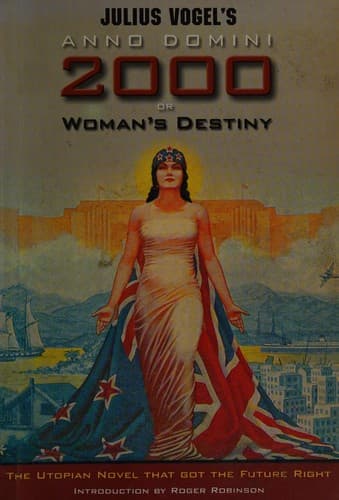
Anno Domini 2000; or, Woman's DestinyVogel, Julius, Sir
Science
Anno Domini 2000; or, Woman's Destiny
Vogel, Julius, Sir
Feminist fiction; New Zealand -- Fiction; Two thousand, A.D. -- Fiction; Utopian fiction; Utopias -- Fiction; Women -- Fiction
"You are a wise judge of the hearts and ways of men and women, and it
would ill become me to disregard your opinion; but, Albert, does it not
occur to you that our Albert might live to regret any renunciation he
made in earlier life?"
"I admit the possibility," said the Emperor; "but he is stable and
mature beyond his years. His dream is to benefit mankind by the studies
he pursues. He has already met with great success in those studies, and
I think they will bring their own reward; but should anything occur to
make him renounce them, he may, I admit, lament too late the
might-have-been."
"Supposing," said the Empress, "he married an ambitious wife and had
sons like you were, dear Albert, in your young manhood?"
"One cannot judge one's self; yet I think I should have accepted
whatever was my position, and not have allowed vain repinings to prevent
my endeavouring to perform the duties that devolved on me."
"Forgive me, Albert, for doubting it. You would, I am sure, have been
true to yourself."
"You confirm my own impression. Recollect, Hilda, true ambition prompts
to legitimate effort, not to vain grief for the unattainable. It may be
that Victoria's own children will succeed; but Albert's children, if
they are ambitious, will not be denied a brilliant career."
"I cannot argue the matter, for it is useless to deny that I refuse to
see our son as he is. I love him to devotion, yet the grief is always
with me that the son is not like the father."
"Hilda dear, he is not like the father in some respects; but the very
difference perhaps partakes of the higher life. When the last day comes
to him and to me, who shall say that he will not look back to his
conduct through life with more satisfaction than I shall be able to do?"
"I will not allow you to underrate yourself. You are faultless in my
eyes. No human being has ever had cause to complain of you."
"Tut! tut! You are too partial a judge." But he kissed her tenderly, and
his eyes gleamed with a pleasure for a very long while unknown to them,
as she brought to him the conviction that the love and admiration of her
youth had survived all the sorrows of their after-lives.
At this juncture the Prince entered the room. "Pardon me," he said. "I
thought my mother was alone;" and he was about to retire. The Emperor
looked at the Empress, and he gathered from her answering glance that
she shared with him the desire that all reserve and concealment should
be at an end. In a moment his resolution was formed. His son should know
everything and decide for himself.
"Stay, Albert," he said. "I am glad to have an opportunity of talking
with you in the presence of your mother."
"I am equally glad, Sir. Indeed, I should have asked you later in the
day to have given me an audience."
"Why do you wish to see me?" said the Emperor, who in a moment suspected
what proved to be the case: that his son anticipated his own wish for an
exchange of confidence.
Public-domain text, read in full here on John Shaqi.
Reviews
Reviews
No reviews yet
Be the first to share your thoughts on this work.
Elsewhere in the archive
Join the Discussion
Join the discussion
Sign in to leave a comment or review.
Sign InorCreate an account