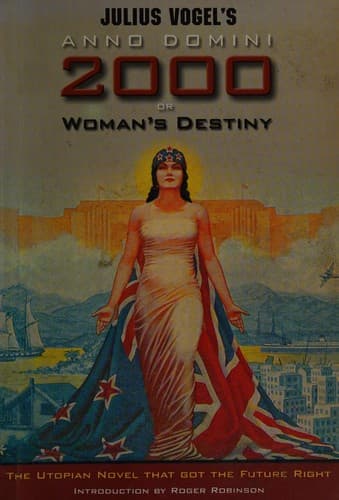
Anno Domini 2000; or, Woman's DestinyVogel, Julius, Sir
Science
Anno Domini 2000; or, Woman's Destiny
Vogel, Julius, Sir
Feminist fiction; New Zealand -- Fiction; Two thousand, A.D. -- Fiction; Utopian fiction; Utopias -- Fiction; Women -- Fiction
"I thank you, Victoria," said the boy gravely. "I am delighted that you
think so well of me. But you must not consider I am making a sacrifice.
My inclinations are entirely against public life. The position of next
heir, and in time of emperor, would give me no pleasure. My
ambition--and I am not without it--points to triumphs of a different
kind. No success in the council or in the field would give me the
gratification that the reception of my paper by the Imperial Institute
occasioned me, and the gold medal which I gained without my name as
author being known. Why I have dwelt on your fitness for the position,
Victoria, is because I do not believe that I should be justified in
renouncing the succession unless I could honestly feel that a better
person would take my place."
"Albert," interposed the Empress, "let your mother say a word before you
proceed further. I will not interfere with any decision that may be
arrived at. I leave that to your father, in whose wisdom I have implicit
faith. But I must ask you, Have you thought over all contingencies, not
only of what has happened in the past or of what is now occurring, but
of what the future may have in store?"
"I have, my mother, thought over the future as well as the past."
"You may marry, Albert. Your wife may grieve for the position you have
renounced; you may have children: they may inherit your father's grand
qualities. Will you yourself not grieve to see them subordinate to their
cousins, your sister's children?"
"Mother, I probably shall not marry; and if I do, my renunciation of the
succession will justify me in marrying as my heart dictates, and not to
satisfy State exigencies. I shall be well assured that whomever I marry
will be content to take me for myself, and not for what I might have
been. As to the children, they will be educated to the station to which
they will belong, surely a sufficiently exalted one."
The Emperor now interposed. "You are young," he said, "to speak of wife
and children; but you have spoken with the sense and discretion of
mature years. I understand, that if you renounce the succession, you
will do so in the full belief that you will be consulting your own
happiness and not injuring those who might be your subjects, because you
leave to them a good substitute in your sister."
"You have rightly described my sentiments," said the boy.
"Then, Albert," said the Emperor, "I will give my consent to the
introduction of a measure that, preserving your rights, will as regards
the future give to females an equal right with males to the succession.
As regards yourself, I think the Act should give you after your majority
a right, entirely depending on your own discretion, of renunciation in
favour of your sister, and provide that such renunciation shall be
finally operative."
Public-domain text, read in full here on John Shaqi.
Reviews
Reviews
No reviews yet
Be the first to share your thoughts on this work.
Elsewhere in the archive
Join the Discussion
Join the discussion
Sign in to leave a comment or review.
Sign InorCreate an account