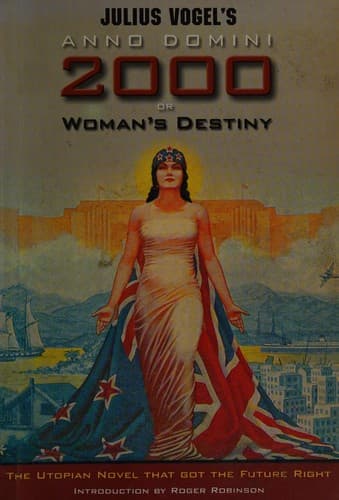
Anno Domini 2000; or, Woman's DestinyVogel, Julius, Sir
Science
Anno Domini 2000; or, Woman's Destiny
Vogel, Julius, Sir
Feminist fiction; New Zealand -- Fiction; Two thousand, A.D. -- Fiction; Utopian fiction; Utopias -- Fiction; Women -- Fiction
Our history for the present ends with the passage of the Act described
by the Emperor; an Act considered to be especially memorable, since it
removed the last disability under which the female sex laboured.
* * * * *
It is perhaps desirable to explain that three leading features have been
kept in view in the production of the foregoing anticipation of the
future.
First, it has been designed to show that a recognised dominance of
either sex is unnecessary, and that men and women may take part in the
affairs of the world on terms of equality, each member of either sex
enjoying the position to which he or she is entitled by reason of his or
her qualifications.
The second object is to suggest that the materials are to hand for
forming the dominions of Great Britain into a powerful and beneficent
empire.
The third purpose is to attract consideration to the question as to
whether it is not possible to relieve the misery under which a large
portion of mankind languishes on account of extreme poverty and
destitution. The writer has a strong conviction that every human being
is entitled to a sufficiency of food and clothing and to decent lodging
whether or not he or she is willing to or capable of work. He hates the
idea of anything approaching to Communism, as it would be fatal to
energy and ambition, two of the most ennobling qualities with which
human beings are endowed. But there is no reason to fear that ambition
would be deadened because the lowest scale of life commenced with
sufficiency of sustenance. Experience, on the contrary, shows that the
higher the social status the more keen ambition becomes. Aspiration is
most numbed in those whose existence is walled round with constant
privation. Figures would of course indicate that the cost of the
additional provision would be enormous, but the increase is more seeming
than real. Every commodity that man uses is obtained by an expenditure
of more or less human labour. The extra cost would mean extra employment
and profit to vast numbers of people, and the earth itself is capable of
an indefinite increase of the products which are necessary to man's use.
The additional employment available would in time make work a privilege,
not a burden; and the objects of the truest sympathy would be those who
would not or who could not work. The theory of forcing a person to
labour would be no more recognised than one of forcing a person to
listen to music or to view works of art. Of course it will be urged that
natives of countries where the earth is prolific are not, as a rule,
industrious. But this fact must be viewed in connection with that other
fact that to these countries the higher aims which grow in the path of
civilisation have not penetrated. An incalculable increase of wealth,
position, and authority would accompany an ameliorated condition of the
proletariat, so that the scope of ambition would be proportionately
enlarged.
Public-domain text, read in full here on John Shaqi.
Reviews
Reviews
No reviews yet
Be the first to share your thoughts on this work.
Elsewhere in the archive
Join the Discussion
Join the discussion
Sign in to leave a comment or review.
Sign InorCreate an account