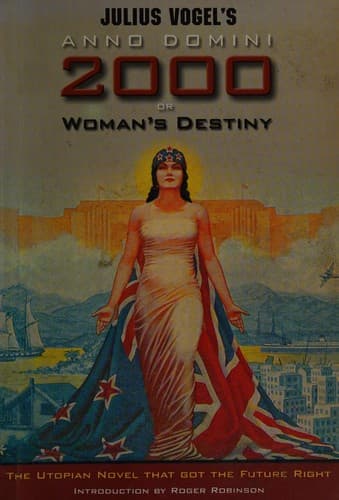
Anno Domini 2000; or, Woman's Destiny — John Shaqi
Anno Domini 2000; or, Woman's DestinyVogel, Julius, Sir
Science
Anno Domini 2000; or, Woman's Destiny
Vogel, Julius, Sir
Feminist fiction; New Zealand -- Fiction; Two thousand, A.D. -- Fiction; Utopian fiction; Utopias -- Fiction; Women -- Fiction
"Yes," replied the Prince, "there is a literature; but does our means
of learning the dead languages enable two persons in ten thousand after
years of study to take up promiscuously a Latin or Greek book and read
it with ease and comfort? They spend much more time in learning Latin
and Greek than their own language, but who ever buys a Latin or Greek
book to read when he is travelling?"
"But a knowledge of Latin is so useful in acquiring living languages."
"Fudge!" said this unceremonious prince, who, by the way, was more than
an average classical scholar. "If I want to go to Liverpool, I do not
proceed there by way of New York. I will back a boy to learn how to
speak and read with interest three European languages before he shall be
able, even with the aid of a dictionary, to laboriously master the
meaning of a Latin book he has not before studied." He continued, "Do
you think one person out of fifty thousand who have learnt Greek is so
truly imbued with the spirit of the Iliad as are those whose only
acquaintance with it is through the translations of Derby, Gladstone,
or even Pope? It is partly snobbishness," he proceeded, with increased
warmth. "The fact is, it is expensive and wasteful to learn Greek and
Latin; and so the rich use the acquirement as another means of walling
up class against class. At any rate, I will destroy the fashion; and so
that there shall be no loss of learning, I will have every Greek and
Latin work not yet translated that can be read with advantage by decent
and modest people rendered into the English language, if it cost me a
hundred thousand pounds: and then there will be no longer an excuse for
the waste of millions on dead languages, to say nothing of the loss
occasioned by the want of education in other subjects that is consequent
on the prominence given to the so-called classical attainments."
The Prince was equal to his word. Science and art, mathematical and
technical acquirements, took the place of the classics; and people
became really well informed. Living languages, it was found, could be
easily learnt in a few months by personal intercourse with a fluent
speaker.
This digression has been necessary to explain how it was that the
volunteers were capable of acquiring all the scientific knowledge
necessary to the ranks of a force trained to the highest military
duties. As to the officers, the position was sufficiently coveted to
induce competitors for command in Volunteer regiments to study the most
advanced branches of the profession.
Public-domain text, read in full here on John Shaqi.
Reviews
Reviews
No reviews yet
Be the first to share your thoughts on this work.
Join the Discussion
Join the discussion
Sign in to leave a comment or review.
Sign InorCreate an account