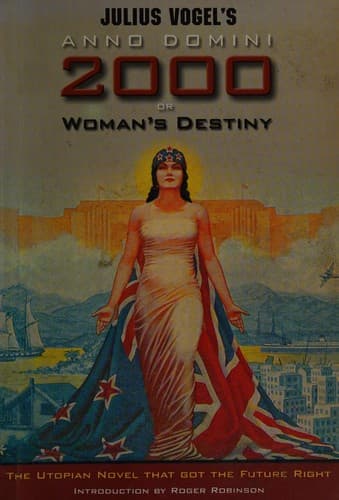
Anno Domini 2000; or, Woman's Destiny — John Shaqi
Anno Domini 2000; or, Woman's DestinyVogel, Julius, Sir
Science
Anno Domini 2000; or, Woman's Destiny
Vogel, Julius, Sir
Feminist fiction; New Zealand -- Fiction; Two thousand, A.D. -- Fiction; Utopian fiction; Utopias -- Fiction; Women -- Fiction
Colonel Laurient was a very remarkable man. He was on his mother's side
of an ancient Jewish family, possessing innumerable branches all over
the world. At various times members of the family had distinguished
themselves both in public life and in scientific, commercial, and
financial pursuits. Colonel Laurient was the second son of one of the
principal partners in the De Childrosse group, the largest and most
wealthy financial house in the world. When his education was completed,
he decided not to enter into the business, as his father gave him the
option of doing. He had inherited an enormous fortune from his aunt, the
most celebrated scientific chemist and inventor of her day. She had left
him all the law permitted her to leave to one relation. He entered the
army, and also obtained a seat in Parliament. As a soldier he gained a
reputation for extreme skill and discretion in the guerilla warfare that
sometimes was forced on the authorities in the British Asiatic
possessions. On one occasion by diplomatic action he changed a powerful
foe on the frontier of the Indian possessions to a devoted friend, his
knowledge of languages and Asiatic lore standing him in good stead. This
action brought him to the notice of the Emperor, who soon attached him
to his personal service, and, it was said, put more faith in his
opinions than in those of any person living. He was rather the personal
friend than the servant of the Emperor.
Some twenty years before the date of our story it was found necessary to
give to the then Sovereign a private service of able and devoted men.
It was the habit of the Emperor of United Britain to travel about the
whole of his vast dominions. The means of travelling were greatly
enlarged, and what would at one time have been considered a long and
fatiguing expedition ceased to possess any difficulty or inconvenience.
A journey from London to Melbourne was looked upon with as much
indifference as one from London to the Continent used to be. It became
apparent that either the freedom of the Emperor to roam about at
pleasure must be much curtailed, or that he must be able to travel
without encroaching on the ordinary public duty of his constitutional
advisers. Thus a species of personal bodyguard grew up, with the members
of which, according as his temperament dictated, the Sovereign became on
more or less intimate personal terms. The officers holding this coveted
position had no official status. If there was any payment, the Emperor
made it. There was no absolute knowledge of the existence of the force,
if such it could be called, or of who composed it. That the Sovereign
had intimate followers was of course known, and it was occasionally
surmised that they held recognised and defined positions. But it was
merely surmise, after all; and not half a dozen people outside of
Cabinet rank could have positively named the friends of the Emperor who
were members of the bodyguard.
Public-domain text, read in full here on John Shaqi.
Reviews
Reviews
No reviews yet
Be the first to share your thoughts on this work.
Join the Discussion
Join the discussion
Sign in to leave a comment or review.
Sign InorCreate an account